
Why some Texas Democrats are forecasting a “Hispanic hurricane” in midterms

Two years ago, President Trump made historic gains with Hispanic voters nationwide and won a majority of Texas Hispanics, upending conventional wisdom and setting back the Democratic Party’s hopes of making the state competitive.
But now, Hispanics may be coming back.
They’re frustrated with the state of the economy and concerned about the Trump administration’s immigration policies. These factors and Mr. Trump’s sagging approval ratings are giving Democrats hope in Texas’ competitive Senate, House and governor’s races.
“There’s a Hispanic hurricane coming,” said Democratic strategist and CBS News political contributor Chuck Rocha, who advises the Democratic Senate and gubernatorial candidates in Texas. “We just don’t know quite yet if it’s going to be Category 2 or Category 5, but it’s washing ashore right in front of the GOP, and they don’t know what to do about it.”
But Republicans say enthusiasm for Democrats is still muted.
An estimated 39 million Hispanic Americans are eligible to vote, an increase of about 5.2 million since 2022, according to the Pew Research Center. Democrats once viewed Latinos as a built-in advantage, predicting that they’d give the party an edge and make some states competitive.
But in 2024, Mr. Trump won about 48% of the group, up 12 points from 2020 and 20 points from 2016, according to Pew’s analysis of validated voters, largely for the same reasons Republicans are losing them now — the economy and immigration policy. Mr. Trump won Hispanic men by two points, despite losing them by 17 points in 2020.
The gains were even more pronounced in Texas, where Mr. Trump won approximately 55% of Hispanic voters in 2024, according to exit polling, turning blue counties in the state’s Rio Grande Valley region light red.
But now, Mr. Trump’s approval rating among Latinos stands at 24%, as of early October, with just 57% of Latinos who voted for the president in 2024 approving of his job performance — down from 93% in February 2025. And 51% of Latino voters said they planned to vote for a Democratic House candidate, compared to 24% who planned to vote for a Republican.
The group — which makes up more than 30% of Texas’ eligible electorate — could prove pivotal in Texas’ closely watched Senate and gubernatorial races.
Six in 10 Hispanic voters planned to vote for Democratic Senate candidate James Talarico over Republican Ken Paxton in an October CBS News poll. Hispanic voters favored Democrat Gina Hinojosa for governor over incumbent GOP Gov. Greg Abbott by a similar margin.
AP Photo/Eric Gay 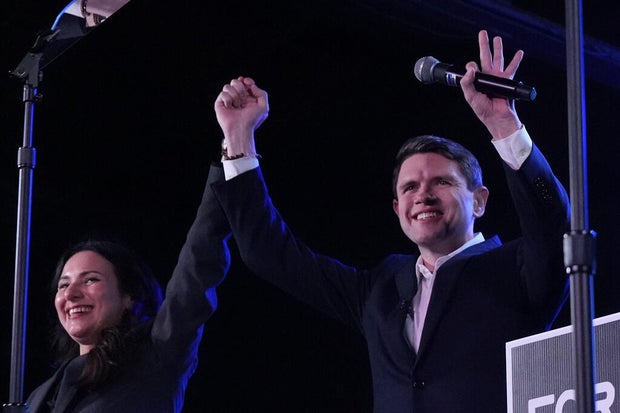
Hinojosa offered her own explanation for Mr. Trump’s success with Hispanic voters in 2024 — and why they may shift back.
“The reason why Trump won, and why he was able to capture the Latino vote in the Valley and in Texas, is because he said the system is rigged – and he’s right. Democrats had been defending a system that is indefensible, that is actually working against us,” Hinojosa told CBS News.
She continued: “People feel betrayed. In this high-cost economy, people just want to know: are you going to work to make my life easier? Greg Abbott has been in charge for 12 years, and it is harder than ever to make it in Texas.”
Mr. Trump has defended his administration’s record with Hispanics.
In Corpus Christi, Texas, he touted Latinos’ economic success, pointing out at a rally for Paxton and other Republicans that Hispanic American poverty fell to its lowest level in history last year, to 13.9% from 15.1% in 2024, according to the U.S. Census Bureau.
The president urged Texans to turn out for Republicans, arguing that Democratic policies would threaten the state’s economy and endanger border security.
He dismisses suggestions that his support among Hispanic voters is slipping, and when asked about it, he pushed back.
“I won Hispanics,” Mr. Trump said in mid-October. “I’ve done more than any other Republican in history. I got tremendous Hispanics.”
The competing messages illustrate the political stakes for both parties in Texas, where no Democrat has won statewide office since 1994 and no Democrat has won a Senate election since Lloyd Bentsen in 1988.
The outcome could have consequences well beyond Texas. Competitive congressional districts in California, Arizona, Florida and Pennsylvania have substantial Latino populations, making even modest changes in voting preferences politically consequential.
AP Photo/Alex Brandon 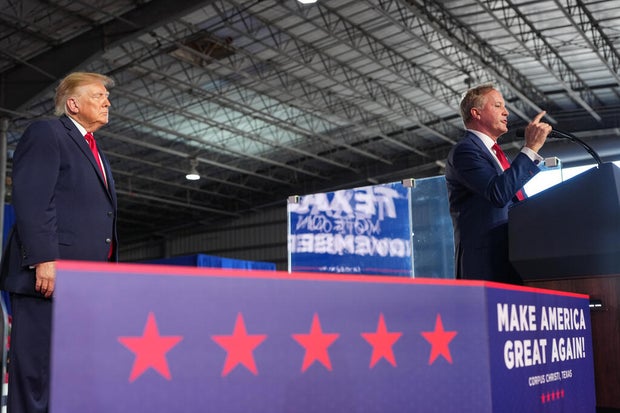
“Monolithically mad”
Rocha said, “Latinos in Texas have probably moved more right than almost any state,” but added that conservative, liberal and independent Hispanics are now really concerned about the economy.
“They’re more monolithic than I have ever seen in my life, and they’re monolithically mad,” said Rocha, the president and founder of Solidarity Strategies.
Rocha said rising prices, fuel costs and affordability are driving much of that frustration — the same issues that have animated voters nationwide. Concerns about immigration policy are adding to unease among some Hispanic voters, especially in South Texas.
He mentioned a Republican homebuilder in the Rio Grande Valley who told him that immigration enforcement had frightened construction workers, making it harder to find labor and prompting him to consider voting Democratic for the first time.
But while immigration is contributing to voter dissatisfaction, he said economic concerns remain the principal motivation.
“Their first thing is always going to be prices and paycheck,” he said.
In Rocha’s view, Hispanics have increasingly looked like swing voters, and have demonstrated a willingness to move between Democrats and Republicans.
“It’s not a realignment; it’s a dealignment,” Rocha said.
He says he is working on 21 congressional races nationally, including several competitive districts with significant Hispanic populations. He acknowledged that his assessment comes from his work advising Democratic candidates.
Democratic Rep. Joaquin Castro of Texas believes immigration, rather than economic concerns alone, is the principal factor behind the heightened engagement among Hispanic voters.
“I think it’s mostly because of ICE and how they have targeted the Latino community in Texas and across the country, and it’s the community standing up and saying enough,” Castro said.
“Grocery prices are high, gas prices are high, but there have been other difficult times, economic times in our nation, and we’ve not seen the same kind of surge of Hispanic voting that we’re seeing now.”
Castro spoke to CBS News Friday, shortly after visiting the Dilley Immigration Processing Center in South Texas, where undocumented families with children are detained. He said he also visited the Karnes County Immigration Processing Center a day earlier, describing a detainee population made up overwhelmingly of Hispanic men.
He argued that Hispanic men have especially been directly affected by the administration’s immigration enforcement operations.
“They feel like they’ve been treated like they’re all criminals, and they’re pushing back,” Castro said. “And I think that the Republican Party is going to pay a very deep, hard price on Tuesday.”
But Castro also said he’s talked with White Texans concerned about how immigrants are being treated.
“It has moved people in a way that transcends race and ethnicity,” he said.
Christopher Lee / Bloomberg via Getty Images 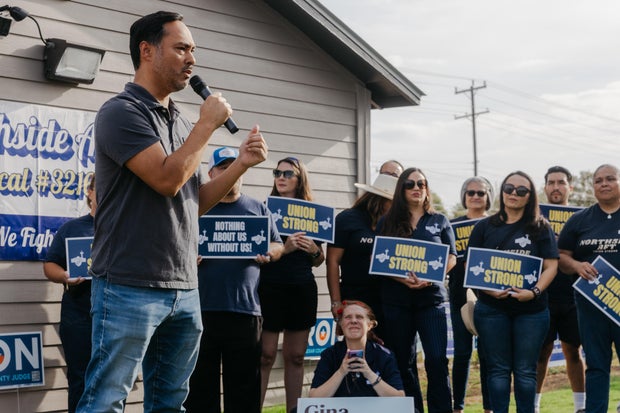
Democrats have also invested more heavily in Latino outreach this cycle than in previous elections, when campaigns frequently waited until the final weeks to translate existing English-language advertisements into Spanish, Rocha says.
For instance, Talarico’s campaign invested $800,000 in World Cup advertising, including Spanish-language ads, to communicate with Hispanic voters through programming they were watching.
Hinojosa’s campaign ran an ad during Mexican boxing superstar Canelo Álvarez’s fight against Christian Mbilli on Saturday, to try to reach Hispanic men.
Both Democrats have also worked with Latino social media influencers, including Carlos Eduardo Espina, whose online following gives them access to Spanish-speaking audiences that campaigns have historically struggled to reach.
Republicans aren’t so sure
GOP officials and their allies say they’re skeptical about a shift of any significance among Latino male voters.
Daniel Garza, president of the LIBRE Initiative, a conservative Latino advocacy group, said he sees little evidence of a Democratic surge in South Texas, where he lives.
“There is no pro-Democrat enthusiasm,” said Garza, who is based in Mission, in Hidalgo County. “I think most voters couldn’t tell you what the Democrat plan is for bringing down prices.”
Garza, a former George W. Bush White House official, argued that Democrats’ outreach to Latino men in particular is unlikely to pay off in a region where many work in energy, law enforcement and federal agencies.
“I have six nephews that are border agents,” he said. “You’re not speaking to them.”
If Democrats have an opening, Garza said, it is more likely with Latina women than with Latino men.
Ideology and religion could also play a role. Highly religious Hispanics are more likely to vote Republican, and even Hispanic Democrats tend to be more religious than the party overall, according to polling data. Plenty of Hispanic Americans also hold conservative views on issues like abortion — and while a majority of Hispanics do not approve of Mr. Trump’s immigration policies, some do.
Garza also argued that Republicans’ baseline of Hispanic support has risen over the past decade, leaving Democrats to fight over a narrower slice of swing voters.
“Ten, 15 years ago, the floor for Republicans was at 25%. That floor has moved up to like 35 to 37%,” he said.
Referring to Rocha and other Democratic strategists, Garza said, “If everything they say is true, they should be dominating down here in South Texas.”
Like Rocha, Garza sees Latino independents growing frustrated with both parties, but he believes that dynamic favors strong Republican candidates.
“I think Latinos are really looking at the quality of a candidate now, as opposed to parties,” he said.
That uncertainty is reflected in recent polling.
A nationwide Pew Research Center survey found just over half of Hispanic voters — 53% — have a favorable opinion of the Democratic Party, outpacing the GOP’s 29% but still highlighting the challenge Democrats may face in translating dissatisfaction into lasting support.
Shifts in the Rio Grande Valley
Early voting figures already point to heightened participation in heavily Hispanic South Texas, including the Rio Grande Valley.
Nearly 150,000 voters cast early ballots in Hidalgo and Cameron counties during the first week of early voting, a 63% increase over the comparable period in the 2022 midterm elections, based on figures reported to the Texas Secretary of State’s office.
The increase is significant in a region where both parties are competing for Hispanic voters. Mr. Trump carried both counties in 2024, becoming the first Republican presidential candidate to win Hidalgo County since 1972 and the first to carry Cameron County since 2004.
AP Photo/Michael Gonzalez 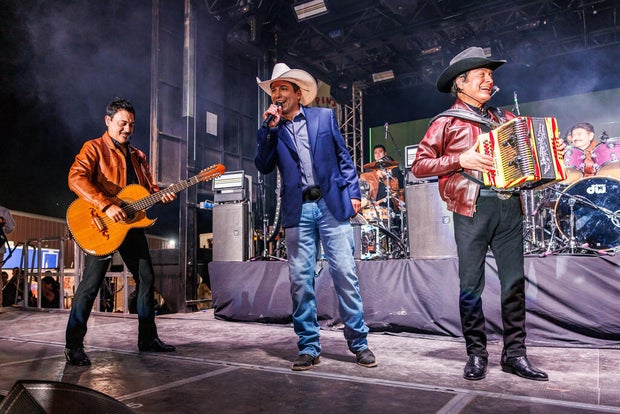
The region is especially important because it’s home to several competitive House districts. GOP Rep. Monica De La Cruz is in a tight battle against Democrat and Tejano music star Bobby Pulido, and Democratic Rep. Vicente Gonzalez is running against Republican Eric Flores.
In a recent interview with CBS News, Pulido described the impact of immigration policy on the district, saying “there’s chaos in the streets” due to “aggressive ICE enforcement.” Pro-Pulido advertisements have often focused on immigration policy.
De La Cruz also told CBS News that “enforcement should focus on the cartels and the criminals, not hardworking immigrant families.” She still predicted Texas would remain red.
“But I do think that it’s a wake-up call for Republicans to remain focused on affordability, and to come to a solution when it comes to immigration,” she said.
Last year’s mid-decade redistricting push adds another dimension. Texas Republicans made Gonzalez’s district and several others redder, a gambit carried out at Mr. Trump’s urging following his 2024 gains among Hispanic voters.
Those changes were designed to improve Republican prospects in several districts where the president performed strongly. But Democrats believe shifting Hispanic political preferences could complicate that strategy.
Michael Gonzalez / Getty Images 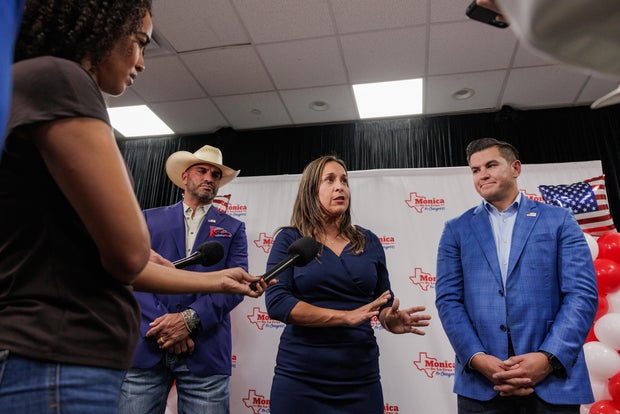
Early turnout figures indicate increased voter engagement, but don’t establish which party those voters are supporting or whether higher participation will benefit Democrats or Republicans.
And Republicans caution against reading too much into early numbers.
A senior GOP strategist, involved in several House races, dismissed Democrats’ optimism as “coming from the same people that have taken Hispanic voters for granted for the last decade.”
“Do I think Hispanics are upset over the high gas prices? Absolutely,” the strategist said. But he argued that frustration does not amount to a clear victory for Democrats.
The strategist pointed to the Rio Grande Valley’s history of ticket-splitting. In 2024, he noted, Mr. Trump carried Hidalgo County even as Democratic House candidates Michelle Vallejo and Gonzalez won majorities there. Gonzalez won his race overall, while Vallejo lost to De La Cruz.
“So for all we know they could be splitting ticket down ballot even if they’re coming out for Talarico,” he said.
For Rocha, the larger question is whether any gains Democrats make this November can be sustained through the 2028 presidential election.
“We’ve now proven this is a very swingy electorate that moves back and forth,” he said.


