Stock Market Simulator for Students: Classroom to College

I hear from two kinds of people about classroom simulators: teachers who need something that works for a room of thirty students, and college students who joined a trading club and want to know if the semester portfolio game they played in high school actually taught them anything. Those are different problems, and the tools that solve them are different too. Most articles on this topic list ten simulators and call it a day. I want to do something more useful: explain the two categories that actually exist, what each one teaches, and how to combine them depending on whether the goal is financial literacy or trading skill.
A stock market simulator for students is a virtual trading environment where students manage practice money against market data, and the options fall into two categories. Semester portfolio games, like the SIFMA Foundation’s Stock Market Game, give student teams a hypothetical account (a $100,000 virtual portfolio in SMG’s case) to build and manage over months, teaching saving, diversification, and long-term investing to grades 4 through 12. Replay-based trading simulators serve the other goal: skill practice. They replay real historical sessions tick by tick so a student can watch price form, place orders against the recorded tape, and repeat a session until a concept sticks, which suits college finance labs, trading clubs, and students preparing to trade their own money. The right choice depends on the goal: literacy programs for younger students, execution practice for older ones.
What Schools Actually Use: The Stock Market Game
The dominant program in American classrooms is the SIFMA Foundation’s Stock Market Game, an online simulation of the global capital markets that has reached nearly 20 million students since 1977. Student teams in grades 4 through 12 manage a hypothetical $100,000 brokerage account, supported by a teacher resource library with lesson plans, assessments, and standards correlations. The foundation has also added InvestQuest, a self-guided mobile experience where users grow a $100,000 virtual portfolio across a simulated three-year period using historical market data, built to introduce investing fundamentals in about half an hour.
For a teacher covering personal finance, economics, or math, this category is the right default. The program is curriculum-shaped rather than trader-shaped: it comes with the classroom structure a portfolio simulator alone would not provide, and it aims at habits (saving, diversification, patience) rather than trading.
What a Portfolio Game Teaches, and What It Does Not
A semester portfolio game teaches students what markets are: why prices move, what a share represents, how diversification softens single-stock risk, and how it feels to hold a position through news cycles. Those lessons compound for life, and the SEC’s own roadmap for students reinforces the same foundation: invest regularly, start early, avoid FOMO, and be careful with apps that nudge you toward overtrading. That last caution deserves emphasis in any classroom: the research note in that same SEC roadmap points out that frequent trading has generally been shown to hurt long-term returns, not help them.
What a portfolio game cannot teach is how markets behave inside a single day, because it was never designed to. Checking a portfolio twice a week builds no intuition for how a stock opens, how volume arrives, or why a breakout fails at lunch. For most students that intuition is unnecessary. For a finance major who wants to understand market microstructure, or a club member who intends to trade, it is the entire subject.
Where a Replay Simulator Fits
This is the second category, and the one I work in. A replay-based simulator loads a real historical session and plays it back tick by tick, with a working order ticket, so the student is not managing a slow portfolio but watching price discovery happen and participating in it. For a college finance lab or a trading club, that changes what you can teach in an hour.
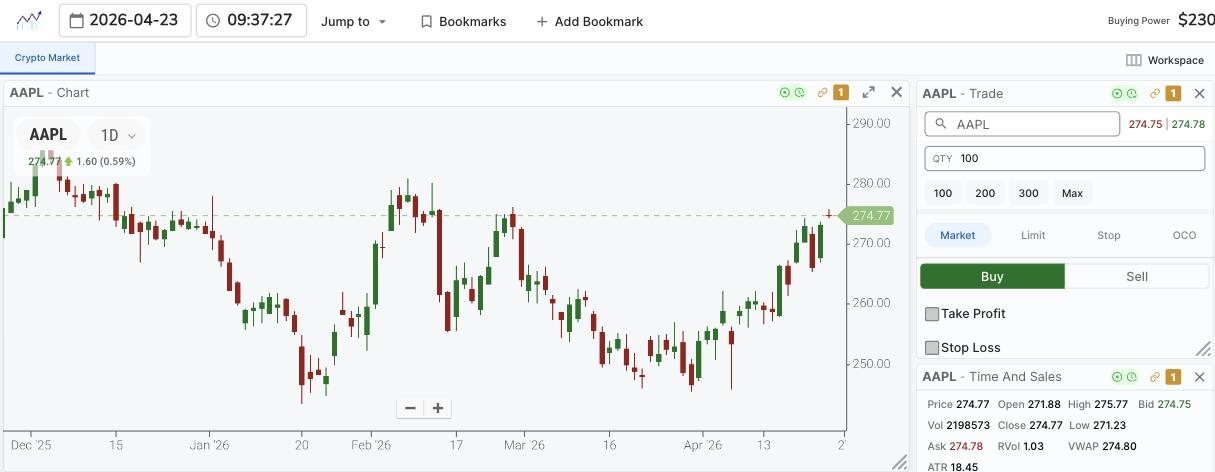
A replay session in TradingSim: AAPL’s daily chart replayed to April 23, 2026 at 9:37:27 AM with the stock at 274.77, a live order ticket, and the time and sales feed printing. A class can watch this session unfold together, pause it at a decision point, and debate the next move before pressing play.
A concrete example of a lab exercise: replay one session as a group, pause at the open, and have students write down the levels they expect to matter. Play forward and grade the calls. Pause again after the morning move and ask what the volume says. An instructor can even frame the session in classic market-structure terms, walking through how Wyckoff’s accumulation and distribution phases show up on an ordinary trading day. You cannot run that exercise on a live feed, because the market only shows you today once, and you cannot run it in a portfolio game, because there is nothing to pause.
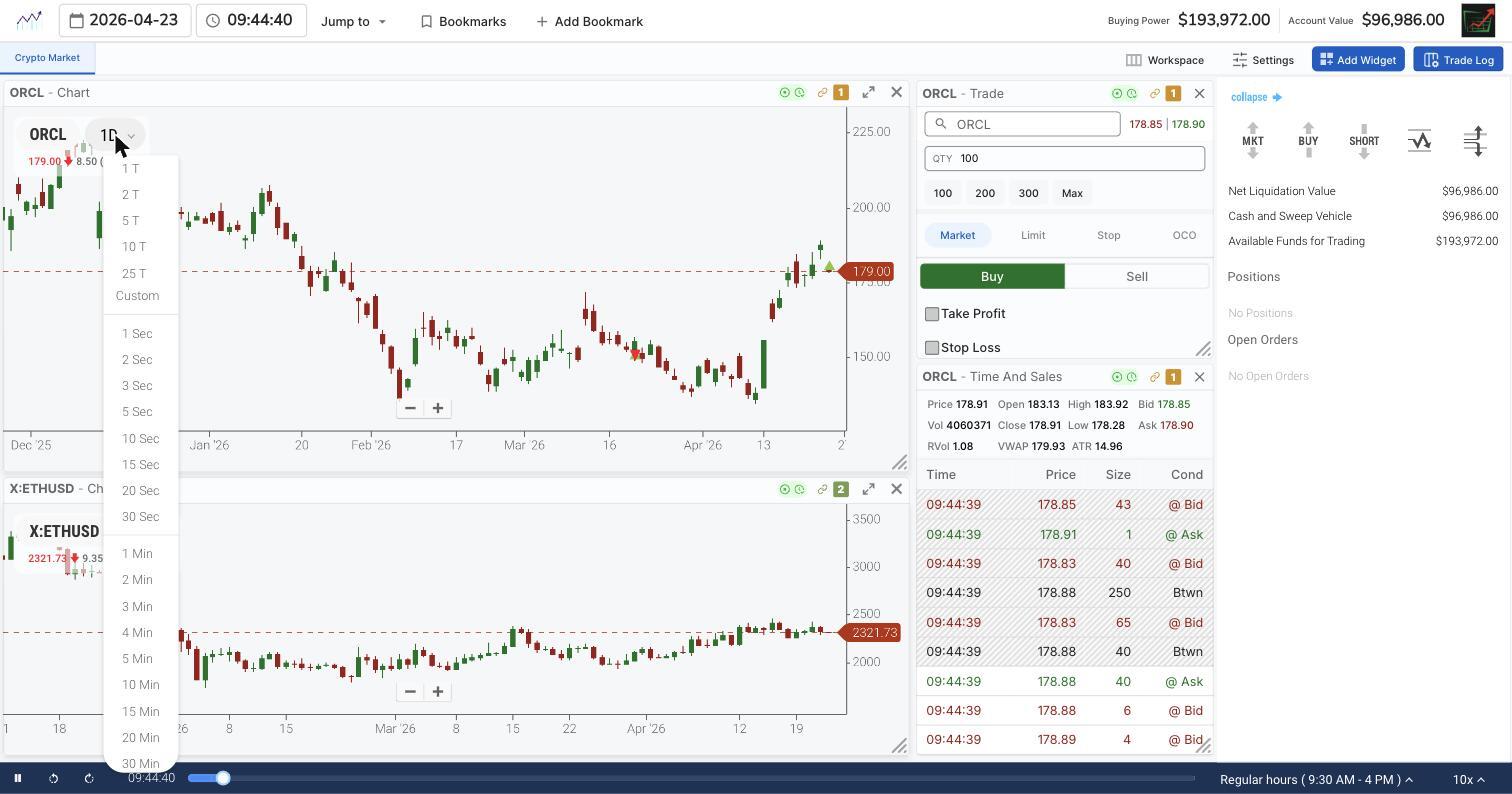
The chart timeframe selector in TradingSim, spanning tick-level intervals through minute charts. Teaching students how the same session looks on a tick chart versus a 5-minute chart is a one-class lesson that a monthly portfolio view cannot deliver.
A Semester That Uses Both
The two categories are not competitors, and the strongest setups I have seen run them in parallel. The portfolio game carries the semester: teams build holdings, track them, and present their reasoning at the end of term. Alongside it, a weekly replay lab handles the market-mechanics half of the syllabus: one real session per week, replayed and discussed, with students keeping a short written log of what they expected and what happened. By the end of the semester students have both the long-horizon habits the portfolio game builds and a working sense of how price actually forms, which neither tool delivers alone. The structured exercises in my practice drills piece adapt directly to lab assignments, and the paper trading basics guide works as a first-week reading.
For College Students Who Want to Trade
If you are the student rather than the teacher, and your interest is trading rather than coursework, be honest with yourself about which category you need. The portfolio game you played in high school taught you what a market is. It did not teach you execution, and jumping from it straight to a funded account skips every hard lesson in between.
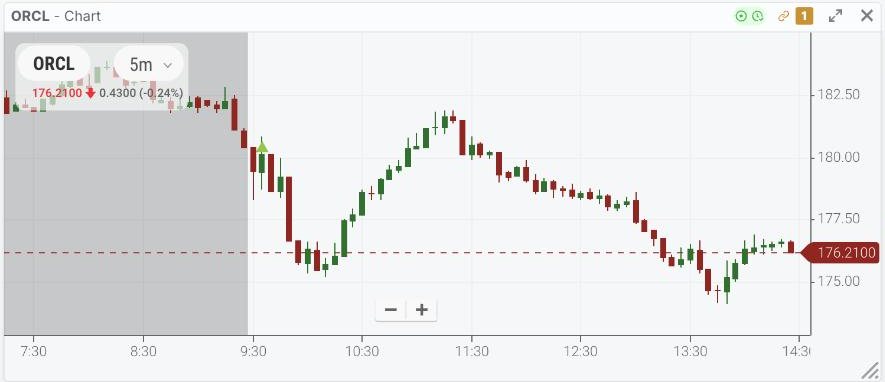
The kind of session a trading club can study end to end: ORCL’s full day on the 5-minute chart, replayed for April 23, 2026. Open 183.13, high 183.92, low 174.08, close 176.21, VWAP 178.11. The gap down, the failed push before noon, and the afternoon fade each carry a lesson, and replay lets you study all three in one sitting.
The bridge is deliberate practice in a stock trading simulator that replays real sessions: build repetitions on one setup, learn the order ticket until it is automatic, and keep a written log, all before real money is involved. I laid out the full case for structured practice in ten reasons to practice day trading, and the SEC’s student roadmap is worth reading alongside it as the guardrail: an emergency fund and controlled spending come before any trading account, simulated or live.
Choosing: Three Questions That Settle It
First, what is the age group? Grades 4 through 12 point to the Stock Market Game and its curriculum support. College and adult learners can handle professional tools. Second, what is the actual goal? Financial literacy points to a portfolio game; understanding intraday markets or preparing to trade points to replay. Third, who manages the experience? SMG is built for a teacher running a class. A professional trading simulator like TradingSim is built for the individual working on skill, which is why finance clubs and individual students get more from it than a fourth-grade classroom would. Match the tool to the job and both categories deliver exactly what they were built for.
Frequently Asked Questions
What is the best stock market simulator for students?
It depends on the goal. For classroom financial literacy in grades 4 through 12, the SIFMA Foundation’s Stock Market Game is the established standard, with a hypothetical $100,000 portfolio and full curriculum support. For college students, finance labs, and trading clubs focused on how markets actually move, a replay-based simulator that plays back real historical sessions is the better fit.
Is the Stock Market Game free for schools?
Access varies by state and program, and some SIFMA Foundation offerings, like the self-guided InvestQuest app, are free. Teachers should check current registration details for their state directly at stockmarketgame.org rather than rely on third-party summaries.
Do stock market simulators use real money?
No. Students manage hypothetical funds against market data, so losses cost nothing. That is the point for education: mistakes become lessons instead of losses. The trade-off is that practice money cannot teach the emotional weight of real risk, which is a reason to keep position sizes small when a student eventually transitions to a real account.
Can a trading club use a day trading simulator for meetings?
Yes, and replay is what makes it work. A club can load a specific historical session, replay it together, pause at decision points, and let members place simulated trades against the recorded tape. A live feed cannot do this because it only shows the current session once.
What should students learn before using any simulator?
The basics the SEC lays out for students: budgeting, emergency savings, the difference between investing and trading, and the research finding that frequent trading tends to hurt long-term returns. A simulator teaches mechanics best when those foundations are already in place.


