
Position Sizing Guide

I’ve seen brilliant traders with 60% win rates blow up their accounts.
I’ve seen average traders with 48% win rates turn $500 into $50,000.
The difference wasn’t the strategy. It was position sizing.
Position sizing is the heart of real trading money management — it’s the difference between a strategy that works and a strategy that works for you, with your account size, at your risk tolerance. It’s the mechanism that lets your edge compound instead of explode.
I know you came here looking for the “perfect” position sizing formula. I’m about to give you three. But first, let me tell you why position sizing is the #1 reason beginners fail — and why fixing it saves your account.
When COVID tanked the market, I started looking for strong buy opportunities as the market was panicking.
Truth be told, I was scared out of my mind. There hadn’t been a modern day example for a global pandemic, so it could have gone either way.
My great idea was to invest in Uber. My thought was Uber would get support from the government and would weather the pullback.
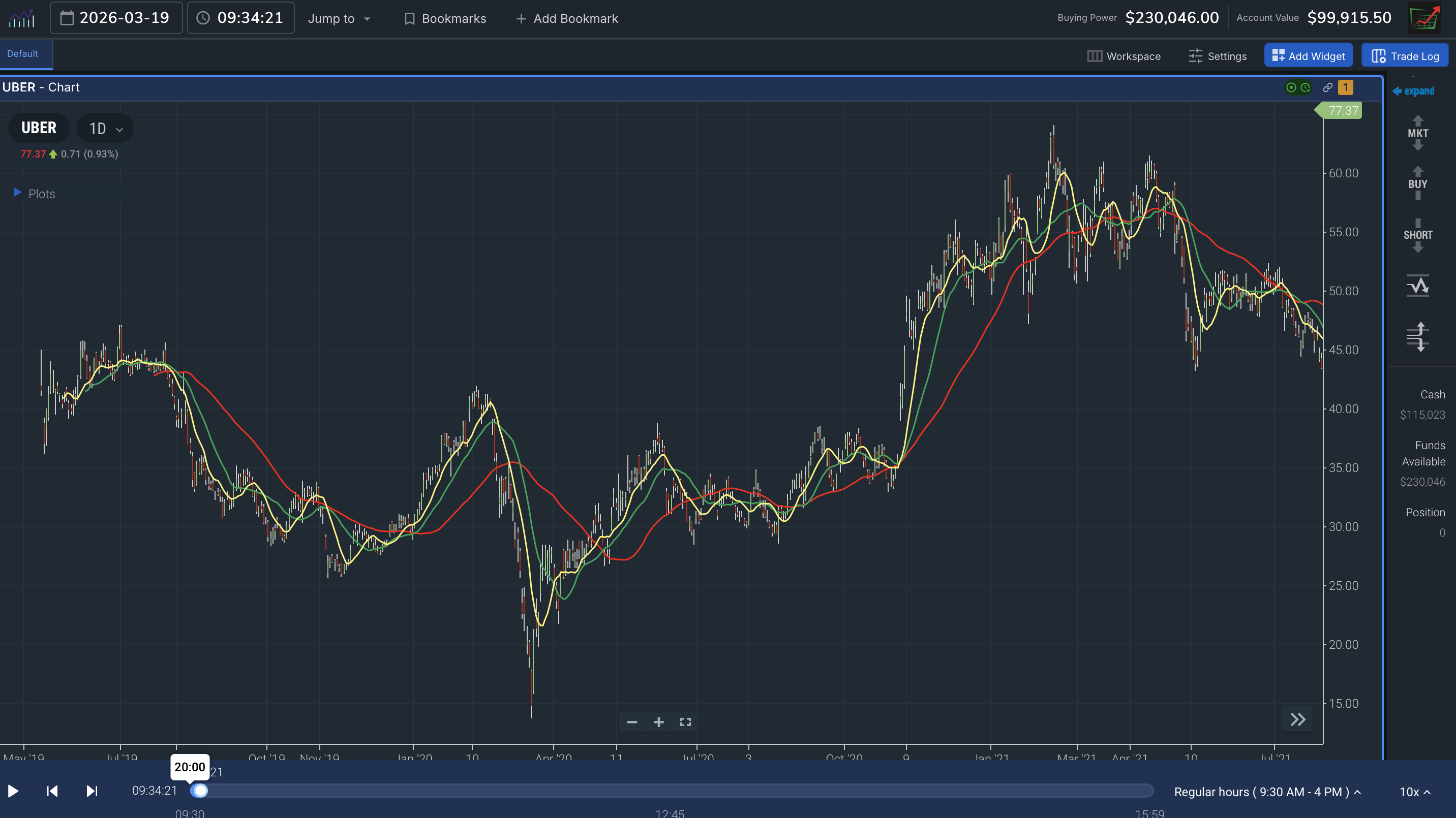
As you can see in the above TradingSim chart, I bought as Uber was tanking. I bought in at the 20 dollar level, only to see Uber tank to a low under 14.
I went in way too large on why position. I remember thinking, if this doesn’t work, this could blow up the 2020 year before it started.
Needless to say, the market and Uber rallied and I was able to get out with a 100% profit, but it wasn’t worth the headache.
What Position Sizing Really Is
Position sizing = how many shares or contracts you trade per position. That’s it. Simple definition, massive implications.
On a $500 account, risking $50 per trade (10% of account) is reckless. One loss and you’re out of money. Two losses and you’ve obliterated yourself.
On a $50,000 account, risking $50 per trade (0.1% of account) is cowardly. You’re underutilizing your capital.
Position sizing bridges the gap. It’s the math that connects your account size to your trade size.
Here’s the problem most traders face: Beginner thinks, “I have $500. I can afford 100 shares of AAPL at $150. So I’ll buy 100 shares.”
But they never asked the right question: “How much can I afford to lose if I’m wrong?”
If AAPL drops 5%, they lose $750 on a $500 account. They can’t afford the loss. They panic, sell at the worst time, and blow up.
A professional asks: “I have $500. I can afford to lose $50 per trade. AAPL is $150. If I set my stop at $145 (5-point loss), how many shares can I trade?”
Answer: 50 ÷ 5 = 10 shares.
So they trade 10 shares, not 100. Same stock, 10x smaller position.
If AAPL drops to $145, they lose $50 (their risk limit). They can afford it. They stay in the game.
Position sizing isn’t about being conservative. It’s about staying in the game long enough to let your edge work.
What is position sizing? Position sizing is the practice of calculating how many shares or contracts to trade based on your account size, acceptable risk per trade, and stop loss distance. The core formula is: Position Size = Account Risk ÷ Stop Distance. Professional traders risk 1-2% of their account per trade. This ensures that even a 10-trade losing streak doesn’t crater your account. Position sizing is more important than win rate, indicator choice, or strategy selection because even a 50% win-rate strategy blows up with wrong position sizing, while a 45% win-rate strategy with proper sizing compounds profits.
The Position Sizing Formula That Changes Everything
This is the formula I’ve used for fifteen years. Memorize it:
Position Size = Account Risk ÷ (Entry Price − Stop Price)
That’s it.
Account Risk = account size × acceptable risk percentage (typically 1% per trade). Entry Price = where you’re buying. Stop Price = where you’re exiting if wrong — this assumes you’re placing hard stop-loss orders, not mental ones.
Let me walk through a real example:
Account: $10,000 Risk per trade: 1% = $100 Entry: AAPL at $150 Stop: AAPL at $145 (5-point stop)
Position Size = $100 ÷ ($150 − $145) = $100 ÷ $5 = 20 shares
You trade 20 shares. If AAPL drops to $145, you lose exactly $100 (1% of your account).
That’s the entire concept. The math is simple, but the discipline to follow it is where most traders fail.
Why 1% risk per trade?
1% is the sweet spot. It’s aggressive enough to compound profits but conservative enough to survive a 10-trade losing streak without a crippling drawdown.
If you risk 5% per trade and take 10 losses in a row, you’re down 50% of your account. You’re back to square one with half your capital left.
If you risk 1% per trade and take 10 losses in a row, you’re down 10% of your account. You still have 90% of capital to recover with.
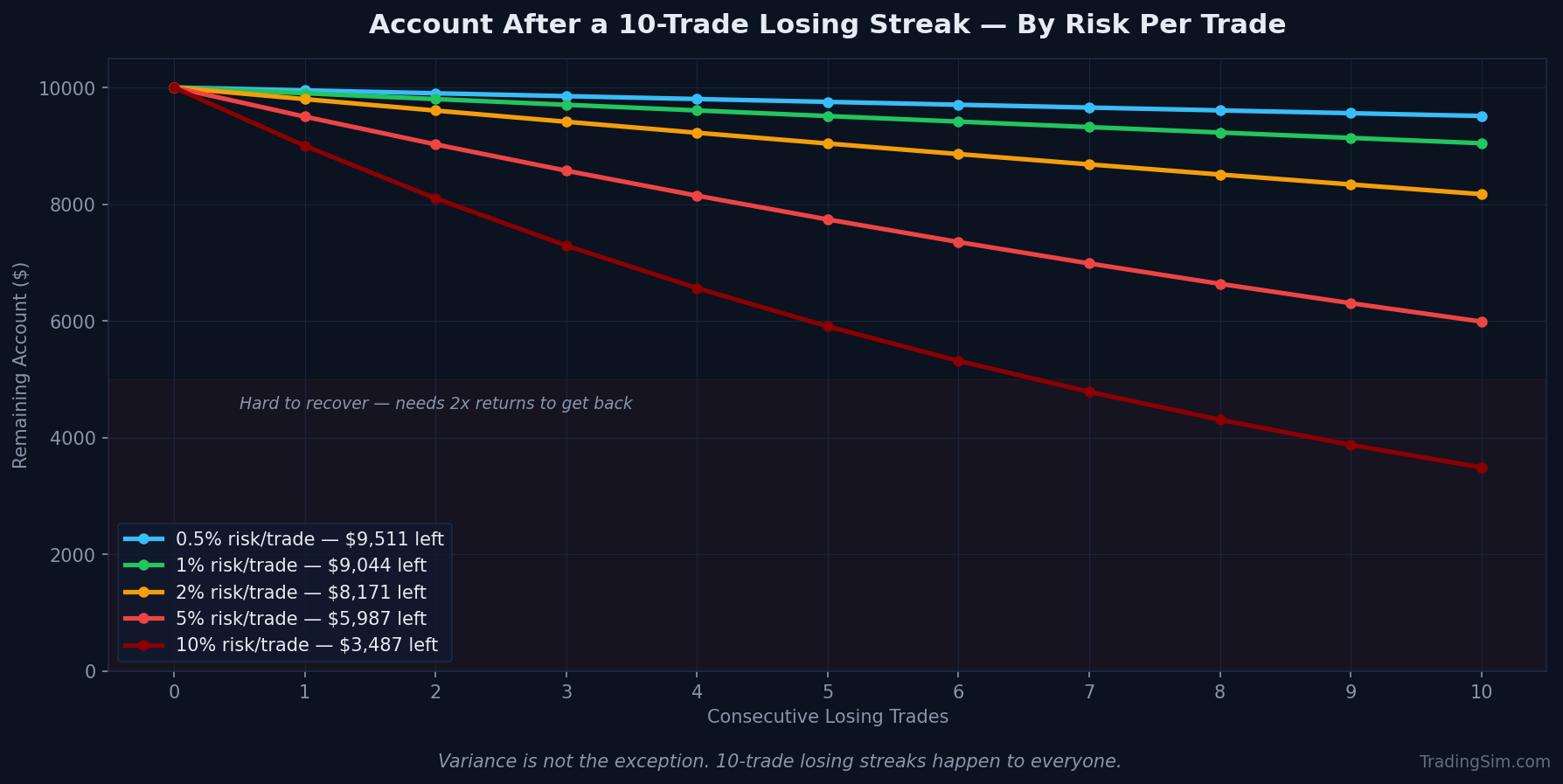
Some traders use 0.5% (very conservative). Some use 2% (aggressive). But 1% is the professional standard that balances growth and survival.
Fixed Fractional vs. Fixed Dollar vs. Kelly Criterion
Not all position sizing methods are equal. Here are the three main approaches:
Fixed Fractional (the 1% rule): Risk 1% of your account per trade. The position size scales automatically with your account.
Advantage: As your account grows, your positions grow. Over 100 trades, fixed fractional compounds faster than other methods.
Disadvantage: You have to calculate position size for every trade.
Example: Trade 1 = $10,000 account, risk 1% = $100. Win the trade, account grows to $10,100. Trade 2 = risk 1% = $101 (slightly bigger position).
Use this if: You want positions to grow with your account. You’re willing to calculate sizes. You have discipline.
Fixed Dollar (same dollar risk every trade): Risk the exact same amount every trade ($100, $50, $10, etc.).
Advantage: Simple. No math required. Easy to track P&L.
Disadvantage: Doesn’t scale. You’re risking the same $100 on a $10k account as on a $100k account (inefficient).
Example: Trade 1 = risk $100. Trade 2 = risk $100 (same, regardless of account balance). Over time, you’re leaving money on the table.
Use this if: You’re a beginner wanting simplicity. You’re testing a new strategy. You’re not serious about scaling yet.
Kelly Criterion (maximum theoretical growth): Formula = (b × p − q) / b. For the full derivation and common traps, see Investopedia’s Kelly Criterion walkthrough.
Where b = risk-to-reward ratio, p = probability of winning, q = probability of losing (1 − p)
Example: – Win rate: 55% (p = 0.55) – Lose rate: 45% (q = 0.45) – Avg win: $100 – Avg loss: $50 – Risk-reward: 100 ÷ 50 = 2:1 (b = 2)
Kelly = (2 × 0.55 − 0.45) / 2 = (1.1 − 0.45) / 2 = 0.65 / 2 = 0.325 = 32.5%
This means you should risk 32.5% of your bankroll per trade for maximum long-term growth.
On a $10,000 account: 0.325 × $10,000 = $3,250 per trade.
Here’s the catch: Kelly is mathematically optimal but psychologically brutal. A 10-trade losing streak costs you 90% of your account.
Professional approach: Use Half-Kelly (Kelly ÷ 2) = 16.25% = $1,625 per trade.
You sacrifice some long-term growth but survive drawdowns better.
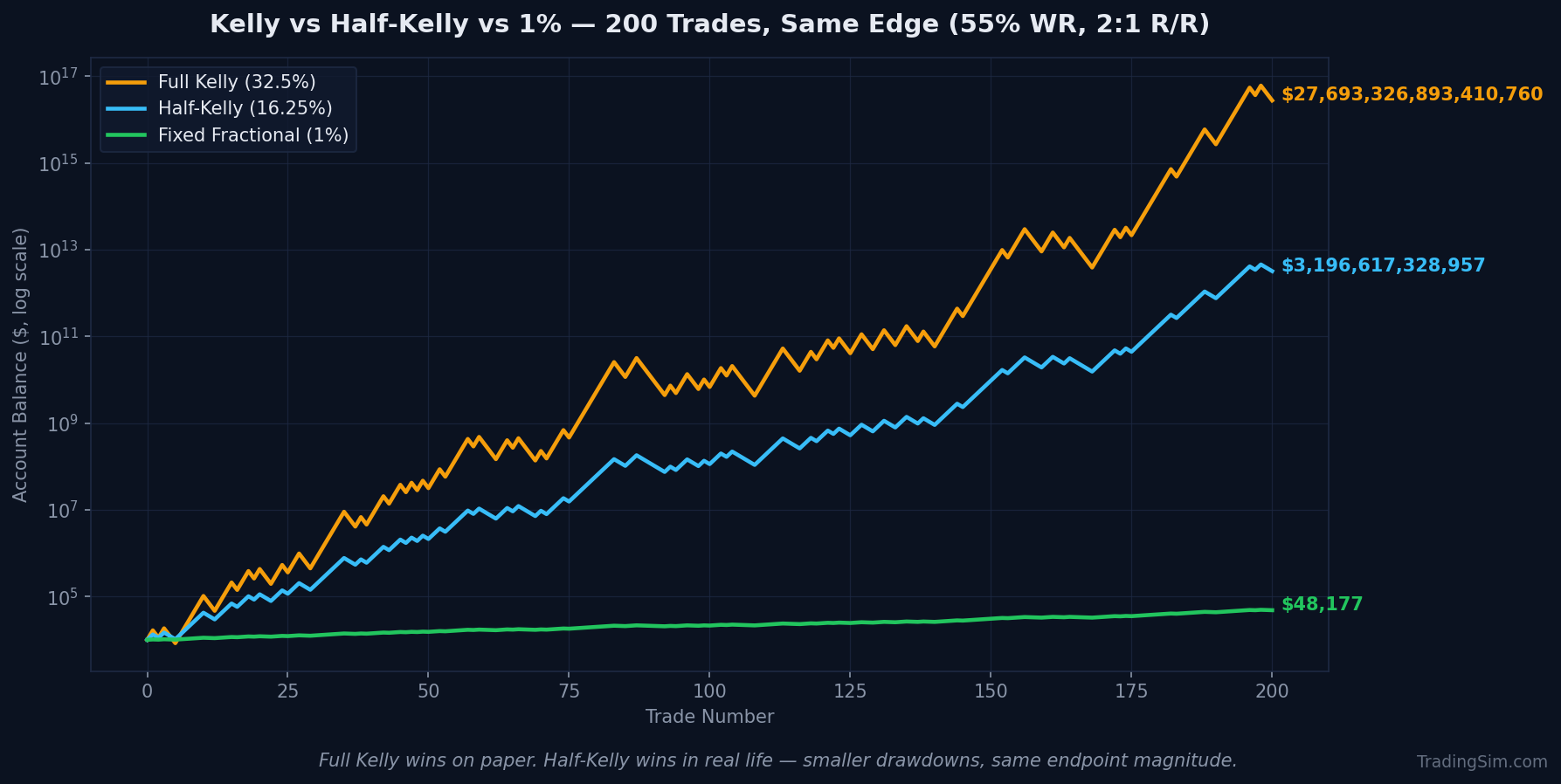
Use Kelly if: You have stable, tested statistics (60+ trades). You want maximum theoretical growth. You’re comfortable with large swings.
Use Half-Kelly if: You want Kelly’s growth benefits with less bankroll risk.
My recommendation: Start with fixed fractional (1%), graduate to half-Kelly once you have 200+ verified trades.
Position Sizing for Stocks vs. Futures
Stock position sizing: Stocks are traded by share count. Your position size is simply the share count.
AAPL at $150, stop at $145, risk $100: – Stop distance: $5 – Shares to trade: 100 ÷ 5 = 20 shares
Easy. You trade 20 shares.
Problem: If you don’t have $3,000 buying power (20 × $150), you can’t execute it. Some setups become unavailable on small accounts.
Futures position sizing: Futures contracts have standardized sizes.
ES contract = $50 × index value. NQ contract = $20 × index value. MES contract = $5 × index value (1/10th the size of ES). MNQ contract = $2 × index value (1/10th the size of NQ).
Position size = contract count, not share count.
ES long at 5,000, stop at 4,990: – Stop distance: 10 points = 10 × $50 = $500 per contract – Risk limit: $100 (on a $10k account) – Problem: Minimum risk = $500 per contract, which is 5x your desired risk.
Solution: Trade MES (micro ES). – MES value: $5 × index value – MES at 5,000, stop at 4,990 (contract multiplier confirmed on CME Group’s official MES contract spec) – Stop distance: 10 points × $5 = $50 per contract – To risk exactly $100, you trade 2 MES contracts. For even tighter sizing, MNQ ($2/point) lets you fine-tune risk in $20 increments.
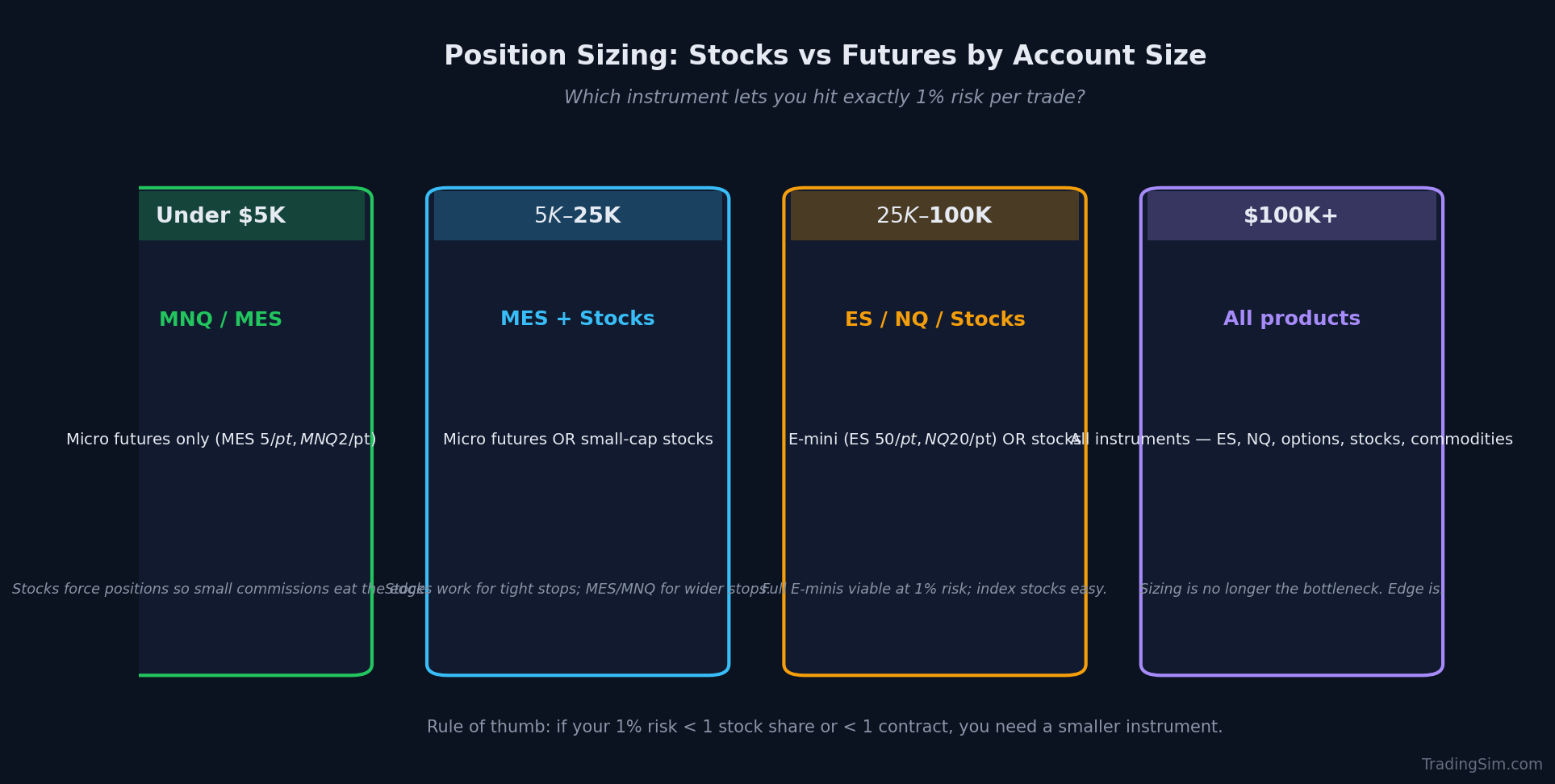
This is why small-account traders should trade micro futures (MES, MNQ), not stocks.
Futures fix the position-sizing problem for accounts under $25,000.
Three Real Trade Examples With Exact Calculations
Let me walk through a live trade using real data from TradingSim. You’ll see the math in action in terms of how position sizing can protect or blow up an account..
Trade: AEHR Short, $10,000 account, 10% risk
Setup: – Account: $10,000 – Risk per trade: 10% = $1,000 – Entry: AEHR breaks below the 50-day simple moving average at $33.45 – Support, $36.79 – Stop: Stop distance: $36.79− $33.45 = $3.34 per share
Calculation: Position size = $1000 ÷ $3.34 = 299 shares
Outcome: AEHR blew through $36.79 like it was butter. Now, if you were adhering to the stop, you would have loss $1,000.
If you put the trade on and did not enter your stop, AEHR ran from the $33.50 range to over $90 in 12 days.
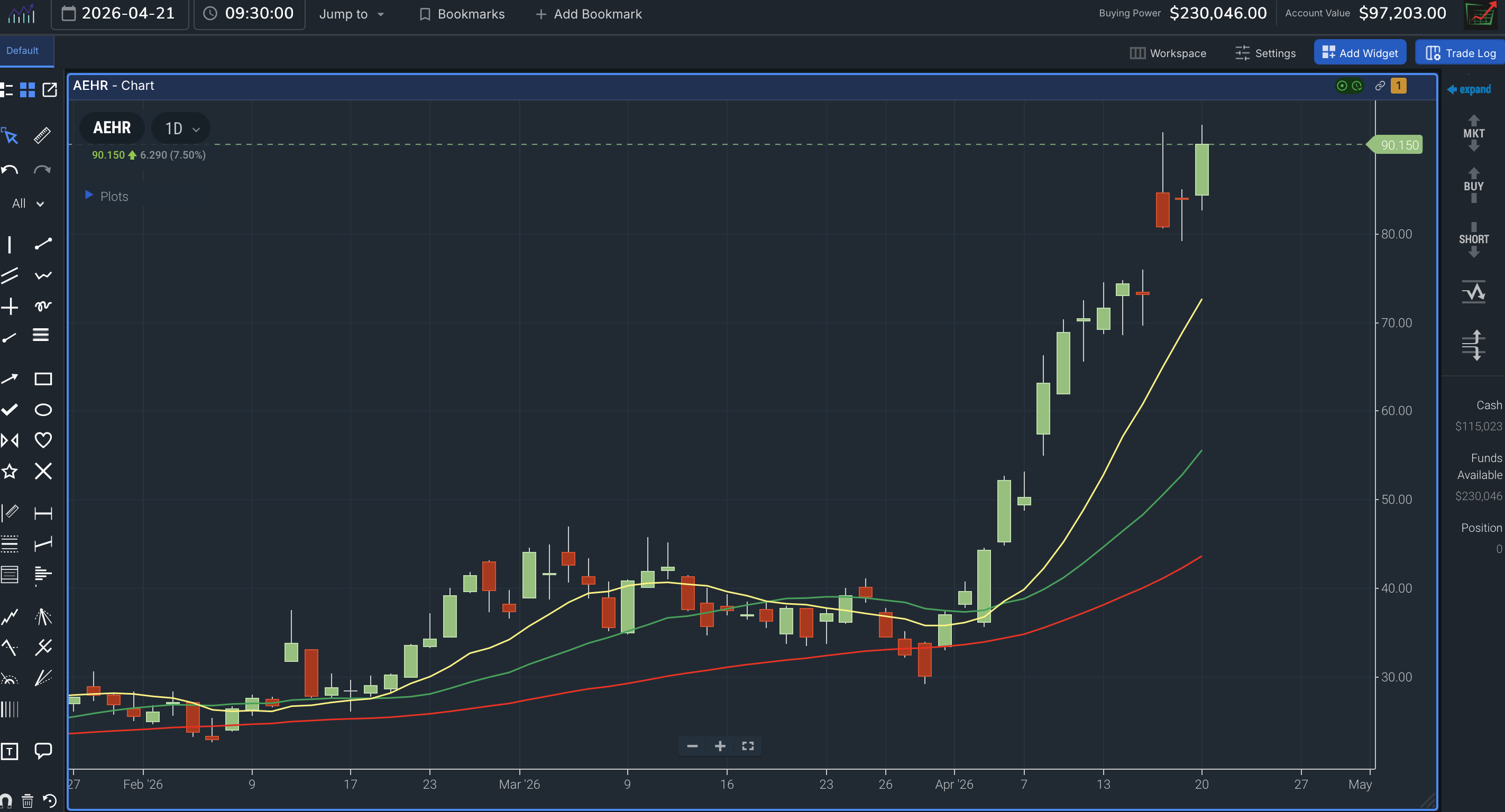
This represented a 170% increase which would have wiped out your $10,000 account. So in this example, while you were only risking 10% of your account, you went all-in with your capital which is a quick way to blow up your account.
So the morale of the story is you will hear about traders who place tight stops, so they size really large. In theory this makes sense, but if you break any of your rules, the risk to your trading account is can be catastrophic.
Common Position Sizing Mistakes (And How to Avoid Them)
Mistake 1: Changing position size based on “feeling good” about a trade.
“This TSLA setup looks really strong. I’m going to trade 200 shares instead of 100.”
This is the fastest path to blowup. You’re doubling position size based on confidence, not math. Trading psychology research is clear — confidence spikes right before the worst losses, not the best wins. The math doesn’t care if you feel good. If you risk 2% on this trade and 1% on the others, your blowup trade will destroy you.
Rule: Position size = math, not emotion.
Mistake 2: Risking too much on the “sure thing.”
You’ve been watching ES consolidate for 2 hours. The breakout is obviously coming. You risk 5% per trade because “this one is different.”
It’s never different. The breakout fails, and you’ve lost 5% of your account on one trade. Variance is real — the SEC’s Investor Bulletin on margin accounts spells out exactly how fast a few leveraged losses cascade. Your 60% win-rate strategy will have 10-trade losing streaks. Position sizing protects you during those streaks.
Rule: 1% risk is 1% risk, regardless of confidence.
Mistake 3: Not accounting for commissions in your break-even calculation.
You trade 100 shares at $150, commission $5 entry + $5 exit = $10.
Your break-even isn’t $150. It’s $150.10 per share. If your stop is $149 (losing 1 point), you’re actually losing $1.10 per share = $110 total loss, not $100.
Always include commissions in your stop-distance calculation.
Mistake 4: Over-leveraging “just this once.”
You see a perfect setup. Your formula says 50 shares. But you want a bigger profit, so you trade 150 shares “just this once.” This is one of the most common ways traders blow up their accounts — not one catastrophic loss, but one “just this once” that becomes a habit.
It loses. You lose 3x what you should have — and if you’re on margin, FINRA’s guidance on margin calls shows how that one oversized loss can force you to liquidate at exactly the wrong moment. You get demoralized and either quit trading or make desperate trades to recover.
Rule: Position size is position size. No exceptions.
Using a Simulator to Practice Proper Sizing
This is where a trading simulator becomes invaluable. You can’t over-leverage. The simulator enforces position sizing discipline.
You set your account size ($10,000). You set your risk per trade (1%). The simulator won’t let you enter a position bigger than your risk allows.
This forces you to do the math 100 times before you go live. When you finally trade real money, position sizing becomes automatic. It’s muscle memory.
If you don’t set a loss limit the market will win every time.
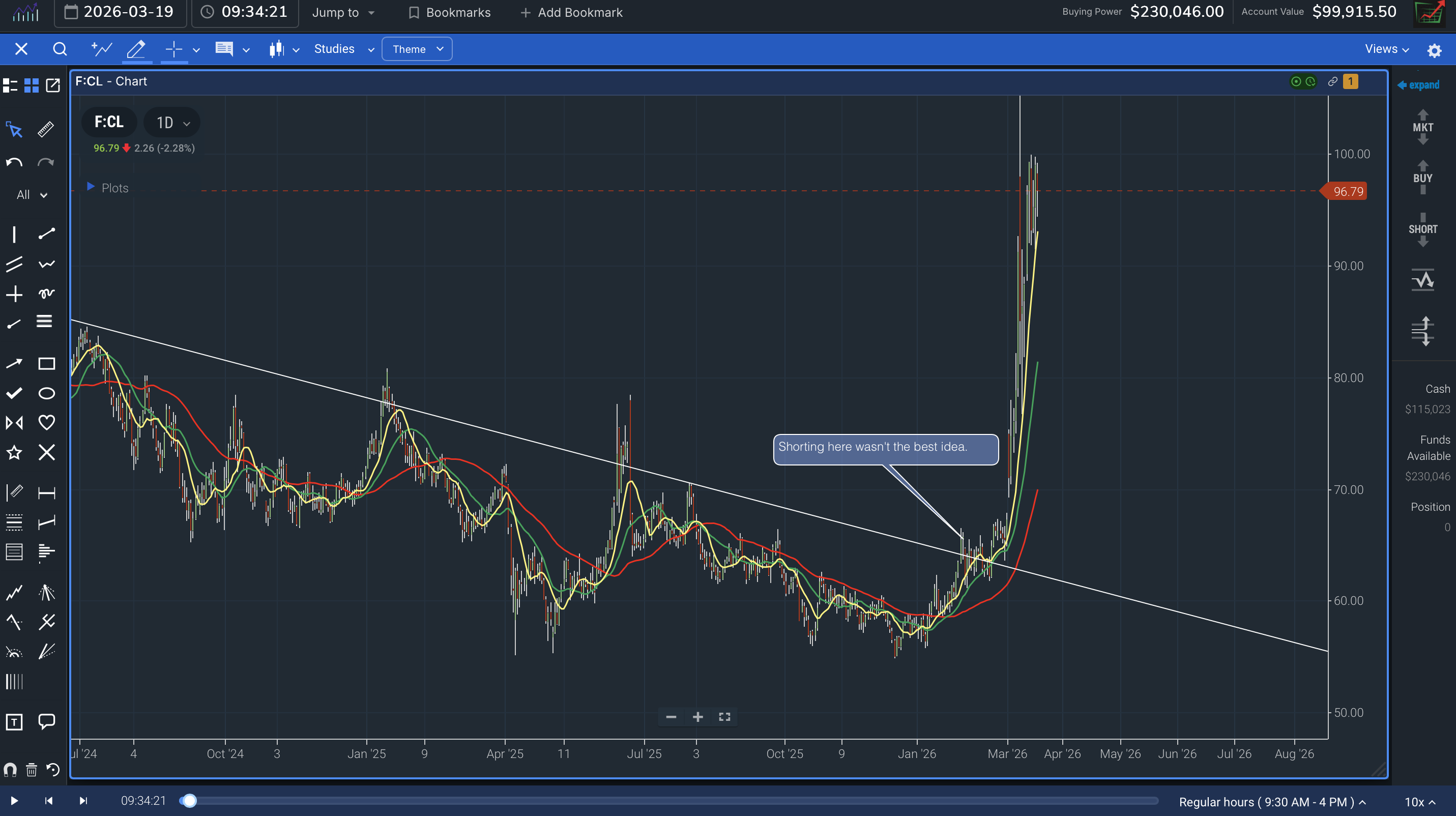
Before the Iran skirmish in late March 2026, oil had been trading a consistent downtrend for close to 4 years. As you can see in the above chart from TradingSim, whoever was short without the proper sizing at the resistance line would have had their block knocked off as the oil futures contract shot up through $100.
Combine oversizing and God forbid leverage, this could literally wipe out a new trader before they have the chance to start.
Position Sizing FAQ
What if my stop is so tight that I’d only trade 1-2 shares?
That means the setup has poor risk-reward. Either find a setup with a wider stop (farther from resistance) or a looser trade (price action farther from reversal). Don’t force small positions on tight stops.
Can I risk more than 1% per trade?
Yes. 2% is common for aggressive traders with stable track records. But 1% is the safest for beginners. Work up to 2% after you’ve proven your edge over 200+ trades.
Does position sizing change if I’m swing trading vs. day trading?
No. The formula is the same. The only difference is your stop distance (usually wider on swings, tighter on day trades), which changes position size automatically.
What if I have a really small account ($500)?
Trade micro futures (MES, MNQ). Stock positions become too small to overcome commissions. If you’re trading stocks on limited capital, work from a dedicated small-account strategy so commissions don’t eat your edge. OR save until you have $5,000. There’s no shame in waiting.
Should I use fixed fractional on a fast-growing account?
Yes. Fixed fractional compounds nicely. If you win 10 trades in a row and your account grows 10%, your position size grows 10%. It accelerates your growth while managing risk.
Do I need different position sizes for different trade types?
No. Apply the same 1% risk rule to breakouts, reversals, day trades, and swings. Consistency matters more than variation.
In Summary
Position sizing is the difference between a strategy that works and a strategy that works for you.
The formula is simple: Position Size = Account Risk ÷ Stop Distance
Use 1% risk per trade. Calculate your position size before entering. Never change it based on emotion.
Over 100 trades: – Fixed fractional (1%) = steady growth, forces discipline – Fixed dollar = simpler, less efficient – Kelly Criterion = aggressive, for advanced traders with proven stats
On small accounts ($10k or less), use micro futures (MES, MNQ) instead of stocks. Position sizing is easier, and you won’t hit minimum position-size problems.
Use TradingSim to practice position sizing 100+ times. Make the math automatic.
When you go live, you’ll size positions without thinking. It’s just math, not emotion.
Remember: the best traders aren’t the ones with the highest win rate. They’re the ones who stay in the game long enough for their edge to work.
Position sizing is how you stay in the game.
Now go test some setups on the simulator and calculate position sizes until it’s muscle memory.


