How To Watch The World Cup

With 104 games over the next six weeks, and with the United States (along with Canada and Mexico) hosting, the World Cup will be all-encompassing for the near future. Soccer is a very easy sport to get drawn into, especially during a World Cup, but the complexity of the game lives below the surface. Sure, you can enter the tournament with minimal knowledge and still appreciate the appeal of a well-hit ball that flies into the top corner, but my hope is that I can break down some of the intricacies of soccer a little, in order to give you a head start on impressing the half-drunk hooligans you might encounter at your local watering hole between now and the final on July 19. Worst case, this guide will serve as an ode to one specific USMNT player I have been a fan of for years, and that feels worth it to me right there.
There’s a famous quote, almost certainly apocryphal, about former Spain and Barcelona midfielder Sergio Busquets that will be helpful here. Supposedly said by World Cup–winning Spanish manager Vicente del Bosque, it goes like this: “If you watch the game, you don’t see Busquets. But if you watch Busquets, you see the whole game.” It’s a little pat, and again almost definitely did not originate from Del Bosque himself, but it still gets at a truth about soccer, which is that most of what’s important in the game happens away from the ball. With that in mind, I want to introduce you to what I will call the Busquets Method, a way to understand what happens and why by looking away from where your eye is most naturally drawn.
Since there are so many games at this expanded World Cup, a casual viewer, one whose job is not to watch hundreds of soccer matches a year and synthesize it all into easily comprehensible analyses, can tackle the How To Watch project piecemeal. With 20 outfield players in every game—I will not be teaching you how to watch goalies; there is an art to it but that’s some 301-level sicko shit—it’s impossible even for a trained eye to keep track of every single player at every single moment. Instead, what I want you to do is pick one player in each game and glue your eyes on him for the entire time he’s on the pitch. Ideally, each game, you will pick a different position, so that by the end of 10 games, you will have watched a player in each section of the field.
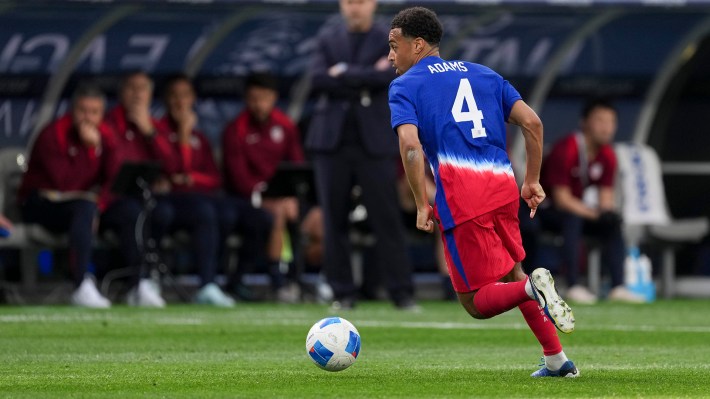
Given that the United States plays on Day Two of the tournament, in something resembling primetime (Friday at 9 p.m. Eastern against Paraguay), let’s for the purposes of this demonstration pick an American player to focus on. Walk with me as we follow Tyler Adams, the Bournemouth midfielder who will be at the center of most of what the United States will do in the most important part of the field. The goal of a defensive midfielder like Adams is to dictate the way that the ball goes from defense to offense. Think of him as an outlet passer on a basketball court, turning upfield as soon as he intercepts a pass or tackles the ball away from an opponent. When Adams gets control of a ball, you should look at the passing options his teammates present him with, as it will explain quite a bit about how USMNT manager Mauricio Pochettino wants his side to play in the most dangerous situations in soccer: the transitions.
If Adams steals the ball and looks down the wings, then the USMNT will be wanting to play a wide, pacey game, with crosses coming in from the wingers and fullbacks. This is how the United States has mostly played throughout its recent history—say, almost the entirety of the 21st century. It fits well with a team that has long been high on physical talent and relatively low on technical skill. The easy play for teams like that is to get the ball into open space and turn on the jets, in hopes of forcing defenses out of their preferred shape and onto the back foot. Plenty of teams will likely deploy this strategy at this tournament, thanks to the overall lower quality of play that comes with a larger field. It’s fine, and it works, and if you see players like Adams immediately look to start the counter-attack the second they pick up their head, you know that you are probably in for a back-and-forth match.
On the other hand, if Adams’s first look after recovering the ball is toward the teammates closest to him in the middle of the field, then there will be different, more interesting impressions to take. While the USMNT will never play a possession-dominant game at the level of prime Barcelona—which isn’t a dig at the Americans; the dirty secret of international soccer is that teams are not together long enough to develop the almost-psychic connections needed to execute the elaborate synchronicities that the best club teams rely on—I would be curious and, were I a fan of the team, encouraged to see Adams turning first toward either to his fellow midfielders—likely to be Juventus’s Weston McKennie and Bayer Leverkusen’s Malik Tillman—or up to Christian Pulisic, who will likely play more centrally than his “winger” designation might imply. (Pulisic is a fun player to watch off the ball and I recommend it, but his true magic is on the ball, so you can get mostly what you need from him just by following that around.) Adams going shorter with his passes but higher with the tempo of the possession will make for a more dynamic USMNT attack, one that can’t be forced out wide and into low-percentage crosses.
The great thing about picking someone like Adams to watch is that, as a ball-winning midfielder, he’s often involved in every action on the field, whether that’s on offense or defense. Like Busquets, who played the same position albeit in a much different way, Adams is the fulcrum upon which the USMNT’s strategies both with and without the ball rest. In other words, you can see the many little moments that compound into a game if you focus your attention on a midfielder like that, because their job connects to everything. By tracking where Adams chooses to go with the ball, you can begin to understand what his team is trying to do and whether they are succeeding. By watching the space he chooses to cut off and whether an opponent gets there or not, you can begin to see dangerous plays developing long before anyone lines up a shot.
Now, with so many games, so many teams, and so many styles, you could easily repeat this exercise for 104 different players and come away with 104 different impressions. That’s the beauty of soccer, a fluid and kinetic sport that resists containment. But, by following the spaces between the passes and the movements leading up to the shoots, you will be able to truly marvel at the cohesion of Spain, the speedy dribbling of France, or the patience of an Argentina side that will look to lull opponents to sleep right before Lionel Messi does something that jolts the whole world awake. With 48 teams, 48 different playing styles, and 48 sets of players all with different abilities and preferences, the World Cup is the perfect time to bask in soccer’s unending horizons. Don’t let anyone tell you that this game or that game is boring because the teams are bad. Instead, pick a player that catches your eye, then track his movements for the rest of the game. You will come away with a more thorough understanding of the sport than someone whose eyes only follow the ball.
Before I send you off into the wilds of this super-sized World Cup, I do want to leave you with some homework. It’s fine enough for me to tell you how to improve your understanding of soccer, but it would be rude to not help you along the way, so here are the six group stage matches I would make sure to watch, and which player I would recommend following while doing so. These are all star players, which makes for an easier introduction, but they also play six broadly different roles for broadly different teams.
- June 13, 6 p.m. ET: Brazil vs. Morocco (Morocco’s Achraf Hakimi)
- June 16, 3 p.m. ET: France vs. Senegal (France’s Michael Olise)
- June 16, 9 p.m. ET: Argentina vs. Algeria (Argentina’s Julián Alvarez)
- June 17, 4 p.m. ET: England vs. Croatia (Croatia’s Luka Modric)
- June 20, 4 p.m. ET: Germany vs. Ivory Coast (Germany’s Jamal Musiala)
- June 26, 8 p.m. ET: Uruguay vs. Spain (Spain’s Pedri)


