
Eight Years Of Rituals With Rosalía

In 2018, I became convinced that flamenco had South Asian origins. I hadn’t listened to much flamenco, if any at all, until my roommate Jake introduced me to Rosalía. I watched her dance—using her feet to strike the ground, making an instrument of her body, raising her arms in intricate flourishes—and I thought … I’ve seen this before. It looked so Indian to me.
Jake and I used to argue about it whenever we watched her music videos, which means we argued about it constantly. Me: “Romani people are from Rajasthan and there is no flamenco without Romani people!” Him: “Bitch, you can’t even spell flamenco.” We didn’t go anywhere without first downing black cherry White Claws and watching the “Con Altura” music video, mimicking her stomps on the brown carpet of our living room. I think I still have the whole thing memorized.
Even though Rosalía experienced success early in her career—her debut album was beloved by critics—it took some time for pop fans to catch up. I remember going to Lollapalooza in 2019 and begging my high school friend to ditch a white rapper named “Yung Gravy” and come with me to catch Rosalía instead. She did, and she thanked me afterwards.
It wasn’t long, though, before Rosalía entered an era of international hits. During lockdown, I’d force my roommates Eleni and Sophie to perform the music video to “La Noche De Anoche,” her duet with Bad Bunny. No amount of the tequila we drank could help Eleni and Sophie’s negative levels of sexual chemistry, but they still did it every time I asked. It’s the kind of fun that only the desperate, drunk boredom of sheltering in place could bring about.
Rosalía’s latest album reveals something new to me each time I listen. Since the day it was released, Lux has been my constant companion, soundtracking my morning commutes, my showers, my first “I love you” to my partner, my aimless time spent staring up at my ceiling. One spring afternoon, I even found myself suddenly prostrating while listening. I felt ridiculous afterwards. What was I doing? I had no sort of belief in anything. Was I so suggestible that a pop album doused in Catholic imagery could lead me to kneel down and pray?
To be fair, Lux goes beyond Catholicism, drawing inspiration from women mystics across religions. Each time a lyric references one of their stories, it’s sung in her language, which is why Rosalía sings in 14 different languages over the course of the album. The Spanish pop star describes it as distinctly feminine, not just because of the women who inspired it, but because of its “intention as a vessel.” Lux is capacious: a classical-pop-opera about delusions of divinity, ruinous devotion, and accepting life for what it is, gratefully.
I spent the last six months anticipating seeing her in concert. I muted the words “Rosalía” and “Lux” and “avant-garde pop” on social media months ago, so when the lights dimmed inside Madison Square Garden, I had no idea what to expect. The gentle sound of violins rose dreamlike, punctured by Spanish trumpets, triumphant and foreboding, heralding Rosalía’s arrival. Two white panels opened slowly to reveal the stage while a flute and trumpet traded jabs back and forth, one playful and the other cautionary.
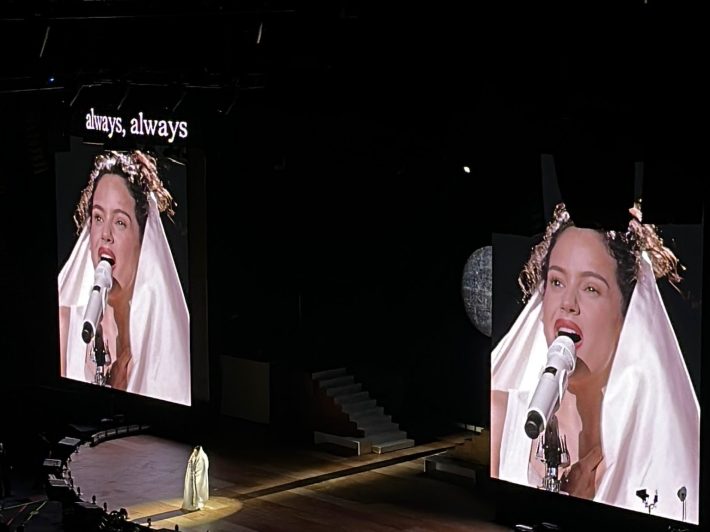
The stage was bare, just two staircases and a giant crate, all cloaked in white cloth and sitting beneath a giant burnt yellow halo. Crew members forced the four walls of the crate down, making the shape of a cross on the floor and revealing Rosalía standing in first position on a small platform, looking like a ballerina in a windup music box. She was wearing the first of many custom Dior looks, a cinched knit ballet top and a white organza tutu skirt encrusted with medallions. Each word she sang floated above us all on a jumbotron ring, like they would at any good popera.
My breath caught at the opening violins of “Reliquia,” quick and insistent, which make the sound of life speeding by. Reliquia’s lyrics are inspired by Santa Rosa de Lima, whose skull, bones, hair, rosary, and tunic have been preserved as relics in shrines around the world. Like the saint, Rosalía too has spread herself across the Earth—losing her tongue in Paris, her eyes in Rome, a lousy love in Madrid—giving pieces of herself to fans, friends, and exes. On stage, she was carried out of her music box like a toy, or maybe a statue, before singing “We’re dolphins jumping, in and out/Of the bright and scarlet ring of time/It only lasts a moment, it only lasts a moment.” The gentle lament, accompanied by melancholic piano, gave way to frenetic synths while the lights flashed on and off and Rosalía moved her arms in perfect sync with her dancers, who come from the Marseille ballet troupe (LA)HORDE.
After the climax of “Reliquia,” she did some sort of ballet walk backwards, and I thought to myself, “Is this woman going to sing en pointe?” With Rosalía, there’s the sense that if in the first act you see a ballet shoe on stage, then in the following she will use it to hoist herself onto her toes. She didn’t make us wait that long. The next song, “Porcelana,” takes inspiration from a monk and poet who, after being denied entry into a Buddhist monastery on account of her captivating beauty, burned and mutilated her own face. For minutes at a time, Rosalía sang in Japanese while on her tippy toes. “I’ll throw away my beauty before you have a chance to ruin it/It’s a talent I was born with.”
There are the talents Rosalía was born with and the ones she worked like a dog to acquire. When she was 15, she appeared on a Spanish television talent show with heavy eyeliner, a wayward side bang, and a dream. She struggled through a frankly painful performance of JoJo’s “Leave (Get Out),” her voice cracking as the camera panned across a panel of frowns. She was predictably turned away and spent the next 10 years studying at the Catalonia College of Music. Her baccalaureate project formed the basis of El Mal Querer, the album that launched her into international fame, which she recorded in an apartment with a microphone, computer, and sound card. “Malamente,” that album’s lead single, mixed flamenco with pop and urban sensibilities. In the song’s music video, she sits open-legged, pantomiming a swagger that isn’t exactly hers. Still, there are interesting elements. The scenes of tracksuited men provoking her with red and gold capes while she rides a motorcycle—the matadors to her bull—are especially memorable. El Mal Querer eventually won the singer her first two Latin Grammys.
Though each of her projects differ quite distinctly from one another, there are throughlines. There’s what Björk—one of Rosalía’s major influences—describes as “kung-fu style” genre-blending, plus Catholic iconography, choreography with a high level of physicality, and a constant insistence on transformation, fueled by borrowing from any culture that intrigues her. Her third album, Motomami, went full Afro-Latino, drawing heavily from reggaeton and other Caribbean influences. Rosalía says she borrows from others with Simone Weil’s sense of love, where “to love is to love the distance between ourselves and the love object.” Loving the distance between herself and reggaeton certainly resulted in enormous commercial success, which gave her the prerogative to love other, more obscure chasms on Lux.
And, honestly, thank god for it. Her vocal talents were on full display when she sang “Mio Cristo Piange Diamanti,” her version of an Italian aria. Christ cries diamonds, and my friend Eleni cried soft tears looking on at Rosalía standing alone on stage, her red lips spilling out one final “sempre” that lifted into a howl and escaped from the confines of the Garden. The singer was crying, too. Before starting the song, she reflected on her very first show in New York City, where she sang for 20 people max, and shook her head in disbelief at whatever propelled her from that night to this one, playing her first sold-out show at “Madison Square fucking Garden.”
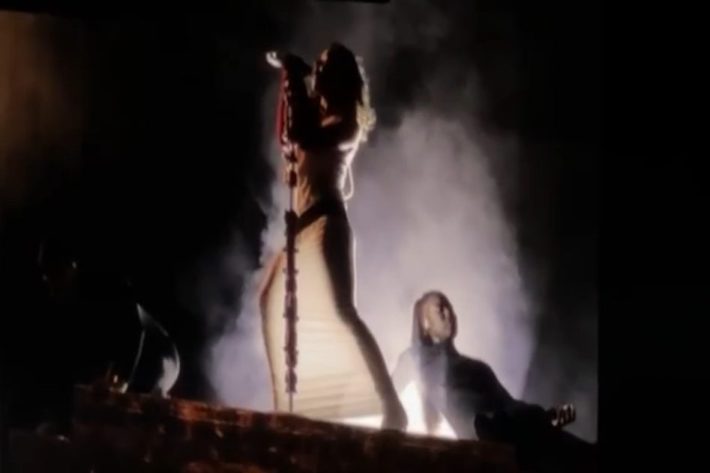
The concert’s most sensuous moment came during Rosalía’s performance of “El Redentor.” The song is Rosalía’s version of an Andalusian saeta, which is a type of flamenco devotional usually sung in public processions during Holy Week. Lit from behind, you couldn’t see her face, just red gloves around the mic and the outline of her body through a white slip. Only a Spanish guitar and the most bare drum beat accompanied her voice.
She ended the concert the way she ended the album, with the ode to self-transformation that is “Magnolias.” It’s a funeral song: an invitation to dance on her cadaver, sing instead of cry, grind her to dust, and send her back from whence she came. The lyrics implore you to release old selves, cede control, and accept your smallness and your fate. In that way, it’s also a love song.
When Lux first came out, I spent hours counting how many words Rosalía sings in each language that makes an appearance on the album. In lots of ways, this was stupid. A graph is a terrible way to make sense of music. But the ritual of making these useless things was meaningful. I needed lots of help to do it, including from the first person who ever showed me Rosalía’s music. Jake dusted off his Hebrew School education to help me parse the references to Miriam in “De Madrugá.” My other best friend told me “It doesn’t work like that” when I asked them to help me quantify the Mandarin in “Novia Robot.” (We settled on our own system of converting Chinese characters into component words.)
Devoting myself with a monastic fervor to recording each and every unit of meaning in the album did not reveal its whole truth to me. But like any good ritual, it provided a permission structure to think and feel deeply alongside people I love. No one counts the beads on a rosary because the beads need to be counted. Eight years of listening to Rosalía, eight years of friendship, and eight years of transformation.
In an interview about Lux, Rosalía cited the Spanish poet and author Alana Portero as one of her inspirations, especially Portero’s encouragement to pray even absent belief as a means of “projecting yourself toward what’s beyond you.” This insight is reminiscent of Leslie Jamison’s memoir The Recovering, in which she describes shrugging off the assumptions of secular humanism to get sober. “I’d come to worship self-awareness,” writes Jamison, “Know thyself, and act accordingly.” But “what if you reversed this? Act, and know thyself differently.”
Jamison moved beyond her disbelief that A.A.’s horribly cheesy slogans and simple rituals could possibly hold any value for her, in all her specialness. “Showing up for a meeting, for a ritual, for a conversation—this was an act that could be true no matter what you felt as you were doing it. Doing something without knowing if you believed it—that was proof of sincerity, rather than its absence.” What could have been more sincere than my ridiculous lyric counting? Or the time I listened to this album and, for some reason I still cannot explain, got on the floor and prayed?
The last few years of my life have been filled by choices like this one: prayers without faith, actions born of some other genuineness than certainty. Why stop traffic in protest of a genocide? Why fall in love? Why write? Why wake up in the morning?
When the weight and transformation of all my years stack on top of me and up to the sky, this album lifts me up to keep choosing life, with a sincerity only possible when the outcome is so unknowable. It’s my relic, my reminder of how wretched and beautiful it is to keep choosing.


