Direxion ETFs: Leveraged & Inverse Funds Guide

Exchange traded funds have become as popular as the assets they track. The main benefit of trading or investing in an ETF is investors can handpick sectors and stocks they want exposure to.
With many ETF providers coming into the market, the competition has also led to cost cutting. These costs cuts make most ETFs quite affordable for retail investors.
Direxion is one of the world’s leading ETF providers. Founded in 1997, the company managed roughly $79.5 billion in assets under management (AUM) as of May 31, 2026 — up from $13.4 billion at the end of 2017.
Direxion offers exchange traded funds, Direxion leveraged ETFs, Direxion inverse ETF and Direxion mutual funds. That’s quite a bit of products uh? Well remember, Direxion has been at this since 1997.
The wide choice of ETFs to choose from makes Direxion’s ETFs widely favored among investors with a greater appetite for risks.
Typically, short-term investors prefer to make use of the 3x leveraged ETFs and the inverse ETFs which allows investors to speculate on both the long and short side of the underlying asset.
Before we go into detail about how to trade Direxion ETFs, let’s first ground ourselves on these financial products.
#1 – What is a Leveraged ETF?
A leveraged ETF is an exchange traded fund that makes use of both financial derivatives and debt in order to amplify the returns of the underlying index or assets tracked.
This is quite different compared to traditional ETFs which simply track or mirror the performance of the underlying indexes or assets.
The aim for leveraged ETF is to simply offer a constant amount of leverage at all times. Typically, this leverage is around 2x or 3x. In other words, it is the ratio of 1:2 or 1:3.
For example, a 3x (three times) leveraged ETF aims to offer investors and speculators additional exposure to the underlying asset or index without any additional costs.
For example, Direxion’s Gold Miners fund (NUGT) targets a leveraged daily result on the NYSE Arca Gold Miners Index before fees and other expenses, and the inverse fund DUST targets the same magnitude in the opposite direction. Important update: NUGT and DUST launched as 3X products but were cut to 2X (200%) in 2020, so they now target 200% and -200% of the index’s daily move rather than 300%.

Direxion’s NUGT (Leveraged Bull ETF) and DUST (Inverse Leveraged Bear ETF)
The most important thing to understand about leveraged ETFs is the fact that they offer daily returns.
Therefore, the typical buy and hold strategy finds no place when it comes to leveraged ETFs, which understandably, makes for a strong topic of disagreement in the investing community.
The keyword here is “daily” as leveraged ETFs offer 300% of the return on the underlying index or assets over the day. However, the returns do not hold ground if one starts to look over the longer-term period.
#2 – What is an Inverse ETF?
Some traders will refer to an inverse ETF as a short ETF or a bear ETF.
Such ETFs are widely used during bear markets and offer investors the advantage of “staying long” while shorting the assets or the index.
An inverse ETF is built by using derivatives that include futures contracts among other derivatives.
Inverse ETFs are in fact a suitable alternative for investors who want to stay on the short side of the market. This brings immense benefits for investors who would otherwise need to hold a margin account in order to short sell the asset.
When combining leverage to an inverse ETF, investors can potentially look at making strong profits. However, despite the promise of huge returns, inverse ETFs are no doubt risky to trade.
#3 – What are Direxion Inverse ETFs?
Direxion’s inverse ETFs are perhaps one of the most widely used exchange traded funds especially in a bear market.
The inverse ETF is also known as the Direxion bear ETF or Direxion bear 3x ETF.
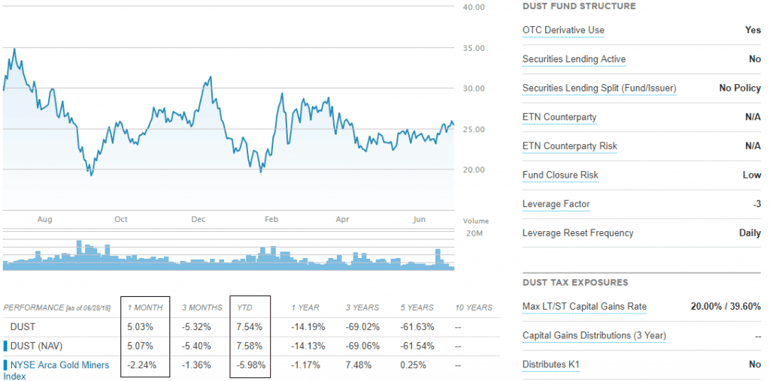
Direxion DUST Bear 3x ETF
The above chart is of the DUST ETF. This is a bear ETF which tracks 30 firms in the precious metals mining industry – primarily in the gold market.
As you can see, the 1-month and year-to-date returns on the NYSE Arca Gold Miners ETF are – 2.24% on the month and 5.98% year-to-date.
If the investor would have instead purchased the DUST ETF and thus shorting precious metals, the inverse ETF holder would have gained 5.03% on the month and 7.54% on a year-to-date basis.
Do you see how not only does an inverse ETF protect your money in bear markets, but it also presents the opportunity to get you ahead.
#4 – Direxion ETF List (Inverse and Leveraged)
The below table shows some of the most popular and widely traded exchange traded funds from Direxion. This list includes the top 10 Direxion ETF assets and their year to date returns.
| Symbol | ETF Name | Total Assets* | YTD* |
| FAS | Direxion Daily Financial Bull 3X Shares | $ 1,886,805.00 | -7.53% |
| NUGT | Direxion Daily Gold Miners Bull 3X Shares | $ 1,233,701.00 | -26.68% |
| SPXL | Direxion Daily S&P 500 Bull 3X Shares | $ 972,693.00 | 0.05% |
| JNUG | Direxion Daily Junior Gold Miners Index Bull 3x Shares | $ 833,798.00 | -26.41% |
| TNA | Direxion Daily Small Cap Bull 3X Shares | $ 730,443.00 | 17.38% |
| TECL | Direxion Daily Technology Bull 3X Shares | $ 688,489.00 | 19.49% |
| SOXL | Direxion Daily Semiconductor Bull 3x Shares | $ 668,843.00 | 2.36% |
| ERX | Direxion Daily Energy Bull 3X Shares | $ 445,404.00 | 7.89% |
| TMV | Direxion Daily 20-Year Treasury Bear 3X | $ 368,043.00 | 7.11% |
| LABU | Direxion Daily S&P Biotech Bull 3x Shares | $ 358,972.00 | 17.98% |
*as of 06/28/2018
2026 correction — read this before using the table above. The assets and returns in that table are a snapshot from June 2018 and are kept here for historical context. Several of those funds no longer carry 3X leverage. In 2020 Direxion reduced leverage on a number of products, and as of August 2026 NUGT and DUST are 2X (Daily Gold Miners Index Bull/Bear 2X Shares), JNUG and JDST are 2X (Daily Junior Gold Miners Index Bull/Bear 2X Shares), and ERX and ERY are 2X (Daily Energy Bull/Bear 2X Shares). SOXL, SPXL, TNA, TECL, FAS and LABU remain 3X products. Always confirm a fund’s current leverage and expense ratio on the issuer’s fact sheet before you trade it — leverage ratios, tickers and share counts change.
One key point to call out is that the top 10 list is made up of the 3X product and not the 2X. This tells me investors are chasing potential profits, but I would love to see how many of these investors are profitable.
If you are looking to purchase a Direxion product, I would say it makes the most sense to start with this list. You can then dig deeper to see if there are other products which may offer a better expense ratios and less volatility.
#5 – Direxion Biotech Bull (Bear) ETF Example
Most investors know that the Biotech sector always makes for an interesting play.
However, when one commonly talks about Biotech ETFs, some of the names that come to mind are IBB (iShares NASDAQ Biotechnology ETF) or XBI (SPDR S&P Biotech ETF). These are the traditional ETFs that offer investors exposure to the sector.
Direxion Biotech Bull and Bear ETFs such as LABD (3x leveraged ETF) or LABU (3x inverse leveraged ETF) are not as popular. These ETFs offer investors the ability to stay long the sector with tremendous upside.
The LABU/LABD tracks the S&P’s Biotechnology Select Industry Index (SPSIBITR). and the LABU ETF.
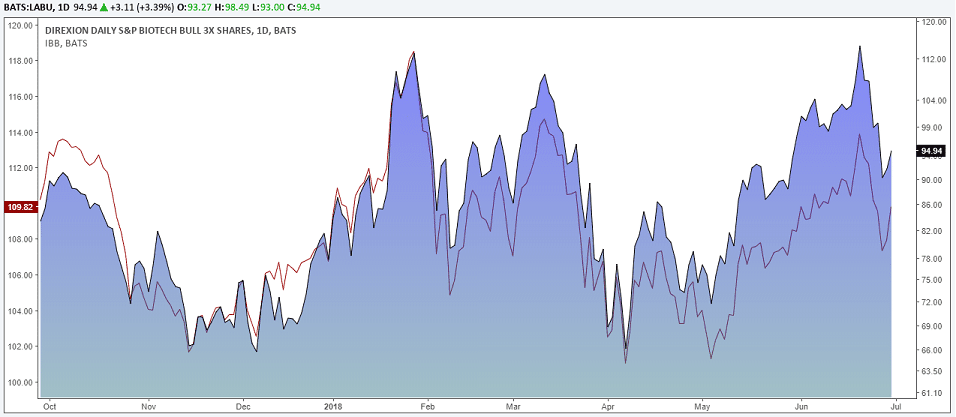
LABU v/s IBB ETF Comparison
The chart above might look similar with both the ETFs tracking more or less the same sector and nearly the same set of companies from the Biotech sector.
But, when one looks at the daily return that is where the similarity ends. While the IBB shows a 0.09% increase, Direxion Bull leveraged ETF has an over 3% range on a daily basis.
Now before you dive into the Biotech ETF, you need to ask yourself why?
Meaning biotechs by themselves are extremely volatile and if played properly will net you big gains.
So again, do you really need the additional risk exposure of a 3X ETF?
#6 – Why Direxion leveraged and inverse ETFs are not for everyone
It is obvious that higher leverage cuts either ways. Investors can expect strong returns while at the same time their risk also increases significantly.
For the short-term investor or speculator, Direxion ETFs offer a great way to quickly realize higher profits especially when they are right. Used wisely, the inverse leveraged ETFs can offer investors the ability to short the market and not only protect their portfolio’s but grow them during downturns.
There is no doubt however inverse and leveraged ETFs carry somewhat higher expense ratios compared to traditional ETFs.
If you are trading Direxion’s leveraged or inverse ETFs for the first time, then exercise caution. This is due to the volatility and the returns that are specific to these ETFs. Investors need to have a strong background and familiarity when trading Direxion ETFs as they can be risky.
The volatility and the daily ranges can lead to significant losses quickly. For example, if you are in a short 3X ETF, every point move is magnified by 3.
Imagine if the ETF has a 20% move, this means you are literally down 60% of your money.
Does this make sense to you? Again, only you can answer that financial question for yourself, but the risk is just insane of you have trouble balancing your portfolio.
However, for seasoned investors, Direxion’s ETFs are the perfect instruments for hedging against potential market volatility. But to think of Direxion as purely a way to make more money is likely a recipe for disaster.
#7 – Leveraged and Inverse ETFs Are for Day and Swing Traders
Leveraged and inverse ETFs are often the cause of polarizing opinions among both investors and speculators alike.
The reason I believe stems from the fact traders begin to look at these ETFs as a means to make three times the return of the market over the same period of time.
The reality is that the swings down will shake the trunk of the most confident trader.
To this point, Direxion themselves have publicly stated these 2X and 3X products are for position/day trades and are not intended for long-term investing.
This means if you have the chops to put on one of these trades, then you need to be a person actively monitoring and trading the markets.
These are not get rich quick products that you can fire and forget.
In the United States alone, there are over 1,800 exchange traded funds listed. Of these, one out of seven ETFs are a leverage or inverse ETF product.
So, with so many choices and needing to know the setups you are trading, if your window is longer and you have no desire to actively manage your account on a daily basis – then purchase a standard ETF.
Leave the volatility to those traders that have the time and capacity to manage these opportunities.
Quick answer: Direxion is a leveraged and inverse ETF issuer with roughly $79.5 billion under management as of May 2026. Its funds target a multiple of an index’s daily move — 2X or 3X, long or inverse — and reset that leverage every session. That daily reset is why they work as trading vehicles and fail as long-term holdings.
What’s New in This August 2026 Update
This guide was last reviewed and refreshed on August 11, 2026. In this revision we corrected the fund’s assets-under-management figure to 2026 data, corrected the leverage ratios on NUGT, DUST, JNUG, JDST, ERX and ERY (reduced from 3X to 2X in 2020), flagged the 2018 fund table as a historical snapshot, added a quick-reference answer and an expanded FAQ, and added cross-links to related TradingSim guides. The original analysis and examples are unchanged.
Frequently Asked Questions About Direxion ETFs
What are Direxion ETFs?
Direxion is a leveraged and inverse ETF issuer founded in 1997, managing roughly $79.5 billion in assets as of May 2026. Its best-known products are daily leveraged funds such as SOXL (Semiconductor Bull 3X) and TNA (Small Cap Bull 3X), plus inverse funds that rise when the underlying index falls.
Are NUGT and JNUG still 3X funds?
No. Direxion cut leverage on several products in 2020. NUGT and DUST are now Daily Gold Miners Index Bull/Bear 2X Shares, and JNUG and JDST are now Daily Junior Gold Miners Index Bull/Bear 2X Shares. ERX and ERY are also 2X. SOXL, SPXL, TNA, TECL, FAS and LABU remain 3X.
Why can’t you hold leveraged ETFs long term?
Because the leverage resets every day. A 3X fund delivers 300% of the index’s move for that session only. Over multiple sessions the daily compounding causes the fund’s return to drift from three times the index’s cumulative return, and in choppy sideways markets that drift is almost always negative.
What is an inverse ETF?
An inverse ETF is built with derivatives so that it rises when its benchmark falls. It lets a trader take bearish exposure in a cash account without borrowing shares or holding a margin account. Like leveraged funds, inverse ETFs reset daily and are designed for short holding periods.
Who should trade Direxion leveraged ETFs?
Active traders who monitor positions intraday and size them for the added volatility. A 3X fund moves roughly three times as fast as the index, so a position sized for a normal ETF is effectively triple risk. They are not appropriate as buy-and-hold or retirement holdings.


