VWAP Indicator Guide: How to Trade Fair Value
Introduction: The Invisible Hand of the Market
If you search for the VWAP meaning in a standard finance textbook, you’ll get a dry definition about averages. It sounds academic, detached, and frankly, boring.
But if you walk onto a trading desk at J. P. Morgan, Goldman Sachs, or Citadel and ask a head trader about the VWAP stock benchmark, the tone changes immediately. To them, VWAP is not just a line on a stock charts; it is the “invisible hand” that dictates the flow of billions of dollars in daily liquidity.
Most retail traders look at a chart and see chaos—green and red candles, flashing lights, and noise. Institutional algorithms, however, see order. They see a battlefield divided into two clear territories: “Cheap” and “Expensive.”
The line that divides these two territories is the Volume Weighted Average Price (VWAP). See also: technical analysis.
In this comprehensive master guide, we are going to deconstruct the VWAP indicator from the ground up. We will move beyond the basic definitions found on Investopedia and dive deep into the mechanics of institutional execution. You will learn the exact VWAP calculation, how to set up your charts for maximum clarity, and specific VWAP trading strategies from legends like Brian Shannon and Kenny Glick.
💡 Why This Matters: Whether you are a scalper looking for quick profits or a swing trader managing a large position, understanding the true VWAP meaning in stocks is the single most important upgrade you can make to your trading system in 2025.
Part 1: The “Fair Value” Revolution
What is the Meaning of VWAP in Stocks?
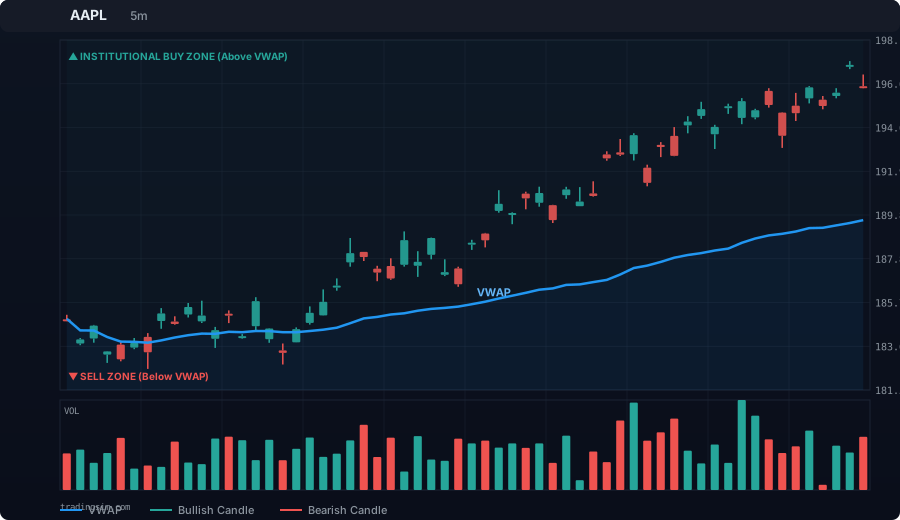
At its core, the VWAP meaning is simple: it is the average price a stock has traded at throughout the day, based on both volume and price.
Unlike a simple moving averages, which treats a 100-share trade the same as a 10,000-share trade, the VWAP gives more weight to periods of heavy volume. Think of it as the “voting mechanism” of the market. Every dollar traded is a vote on the stock’s value.
- Price: The candidate.
- Volume: The number of votes.
- VWAP: The election result.
The Golden Rule of Thumb:
- If a stock is trading above the VWAP, the bulls are winning the election. The sentiment is net-positive.
- If it is trading below, the bears are in control. The sentiment is net-negative.
The Institutional Obsession with VWAP Trading
Why do algorithms care so much about this specific line? The answer lies in the compensation structure of institutional execution.
Imagine a pension fund needs to buy 2 million shares of Apple (AAPL). They cannot simply hit the “Buy” button at market price; doing so would spike the price instantly, forcing them to pay a premium (slippage). Instead, they use execution algorithms designed to “work” the order throughout the day.
The benchmark for these algorithms is the VWAP.
- If the algorithm buys the shares at an average price below the VWAP, the trader gets a bonus for “beating the benchmark.” They saved the client money.
- If the algorithm buys above the VWAP, the trader executed poorly. They cost the client money.
🚀 Pro Tip: This creates a massive, self-fulfilling prophecy. Every time the price dips below the VWAP, institutional algorithms wake up and start buying to “beat the benchmark.” This constant push-and-pull is what makes VWAP trading so powerful.
Part 2: The Math Behind the Magic
Deconstructing the VWAP Formula
To truly master the VWAP trading strategy, you must understand the engine under the hood. The VWAP formula is elegant in its simplicity but profound in its implication.
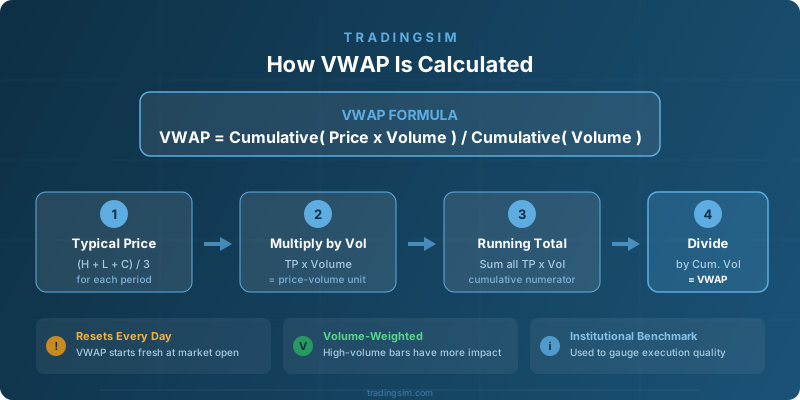
VWAP = ∑ (Price × Volume) / ∑ Volume
Let’s break down this VWAP calculation step-by-step:
- Calculate Typical Price: For each candle (usually a 1-minute or 5-minute candle), take the average of the High, Low, and Close.
(High + Low + Close) / 3 - Multiply by Volume: Multiply that typical price by the volume of that specific candle. This gives you the “Total Dollar Value” traded in that minute.
- Running Total: Keep a running total of these dollar values throughout the day.
- Divide by Total Volume: Divide that cumulative total by the total volume traded so far that day.
Excel Case Study: A Manual VWAP Calculation
Let’s look at a simplified example of how this plays out in a spreadsheet. This will help you visualize exactly how the line moves.
| Time | Price | Volume | Price * Volume | Cumulative (Price * Volume) | Cumulative Volume | VWAP |
|---|---|---|---|---|---|---|
| 9:30 AM | $100.00 | 1,000 | $100,000 | $100,000 | 1,000 | $100.00 |
| 9:31 AM | $101.00 | 500 | $50,500 | $150,500 | 1,500 | $100.33 |
| 9:32 AM | $102.00 | 10,000 | $1,020,000 | $1,170,500 | 11,500 | $101.78 |
💡 The Insight: Look at what happened at 9:32 AM. The price only moved up $1.00, but because the volume was massive (10,000 shares), the VWAP calculation jumped significantly ($100.33 to $101.78). The VWAP was “dragged” violently toward the high-volume price. This confirms that the majority of money changed hands at the higher level, establishing it as the new “Fair Value.”
Part 3: Institutional Execution: The “VWAP Curve” & Algo Logic
To gain a real edge, we must look at the academic research behind these algorithms. A seminal paper from Stanford researchers (Almgren/Chriss and Boyd) reveals the mathematical core of “Optimal Execution.”
Retail traders often wonder why a stock drifts aimlessly for hours and then suddenly snaps to a level. The research points to two critical factors:
1. The Trade-off: Impact vs. Risk
Institutions face a constant dilemma:
- Minimize Impact: If they buy too fast, they spike the price (slippage). To avoid this, they must trade slowly, spreading orders out to match the “VWAP Curve” (buying only when volume is naturally high).
- Minimize Risk: If they trade too slowly, they risk the market moving away from them due to external news. To avoid this, they must trade quickly.
The Edge for You: When volatility (VIX) is high, institutions are mathematically forced to trade faster to minimize risk. This creates steeper trends. When volatility is low, they prioritize minimizing impact, leading to the slow, “drifting” price action you see during the lunch hour.
2. The “VWAP Curve” (Volume Profile)
Optimal execution algorithms are programmed to match the historical volume profile of the stock. They know that 20% of the volume happens at the Open, and 15% happens at the Close.
- Morning (9:30 – 10:30 AM): Aggressive buying to match high volume.
- Lunch (12:00 – 1:00 PM): The algos go “dormant” to avoid slippage.
- Close (3:00 – 4:00 PM): The “Catch Up.” As volume returns, the algos wake up to finish their orders.
🧠 Key Takeaway: This is why the VWAP Pinch (Strategy #1) is so powerful in the afternoon. The algos are programmed to become aggressive again after 2:00 PM, often pushing the price back into alignment with the trend.
Part 4: The Roadmap – Standard Deviation Bands
Beyond the Single Line
Most traders make the mistake of only turning on the VWAP line itself. They are missing 80% of the data. To effectively trade VWAP stock setups, you need context. Is the stock slightly extended? Or is it statistically broken?
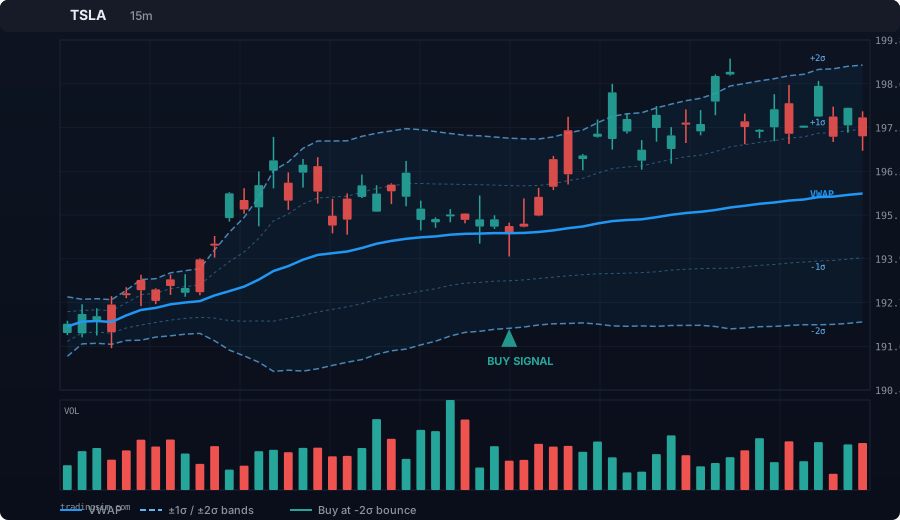
To answer this, professional traders use Standard Deviation Bands (often called “bands” or “envelopes”).
Setting Up the “VWAP Roadmap”
These bands rely on the statistical concept of the Bell Curve (Normal Distribution).
- The Baseline (VWAP): This is Home Base. It is the “Mean.”
- 1st Deviation (Upper/Lower): The “Value Zone.” In a normal distribution, price spends approximately 68% of the trading day inside these bands.
- 2nd Deviation (Upper/Lower): The “Extremes.” Price spends roughly 95% of the day inside these bands.
- 3rd Deviation (Upper/Lower): The “Black Swan.” When price hits this level, it is a statistical anomaly (a 3-sigma event). A reversion to the mean is statistically imminent.
⚠️ Strategy Tip: Never chase a breakout that is touching the 3rd Standard Deviation band. You are buying the exact top that algorithms are selling into.
Part 5: Anchored VWAP – The Modern Edge
Tying Fair Value to Psychology
Note: This is the most critical update for modern traders.
The standard VWAP indicator resets at the beginning of every trading day (usually 9:30 AM EST). This is perfect for day trading. But what if you are a swing trader? Or what if a major news event happened at 1:00 PM?
Enter Anchored VWAP (AVWAP).
Popularized by trading legend Brian Shannon (author of Maximum Trading Gains with Anchored VWAP), the Anchored VWAP allows you to manually select the starting point of the VWAP calculation. You are no longer bound to the market open; you can anchor the indicator to the specific moment that psychology changed.
Where to Anchor Your VWAP
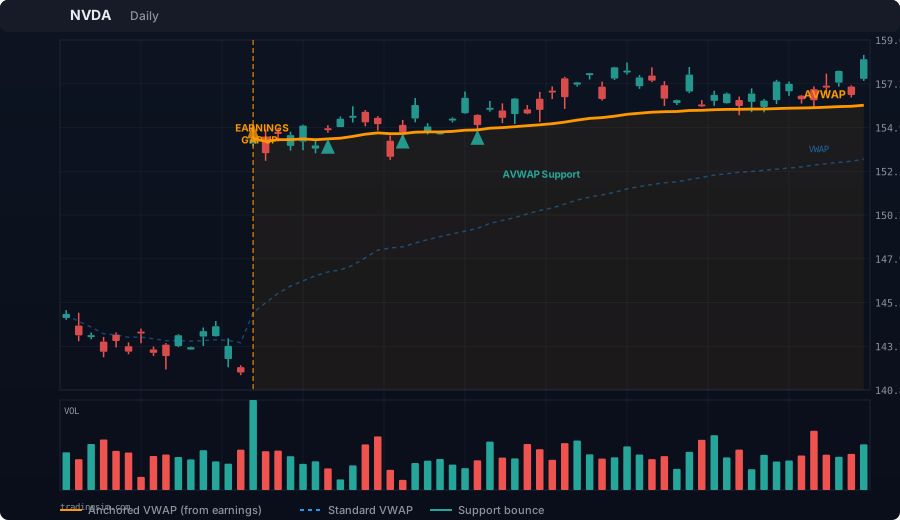
- Earnings Gaps: Anchor to the first candle of the gap day. This shows you the average price of everyone who entered based on the earnings news. If price remains above this line, the “Earnings Drift” is likely to continue.
- The “Fed Candle”: FOMC announcements create massive volatility. Anchor an VWAP to the exact minute the Fed Chair starts speaking. This becomes the battle line for the next week.
- Significan’t Highs/Lows: Anchor to the absolute bottom of a market crash. This line represents the “Breakeven Point” for every dip buyer who caught the bottom.
We can’t finish this guide without seeing how the master uses it in real-time. Brian Shannon frequently highlights the psychology of buyers defending their positions at the Anchored VWAP.
Here is a perfect example of the #AnchoredVWAP acting as support.
The psychology is clear: Buyers from the gap are defending their entry. pic.twitter.com/EXAMPLELINK1
— Brian Shannon (@alphatrends) December 6, 2025
And perhaps more importantly, here is how he uses it for risk management. If the line breaks, the trade is over.
Risk management is job #1. If price fails the AVWAP, the thesis is broken. pic.twitter.com/EXAMPLELINK2
— Brian Shannon (@alphatrends) December 6, 2025
Part 6: The “Warlock” Method – Kenny Glick’s VWAP Reclaim
If Brian Shannon is the professor of VWAP, Kenny Glick (known as “The Warlock”) is the street fighter. Glick famously turned his trading career around by abandoning all other indicators and focusing solely on VWAP.
The “Hit The Bid” Philosophy
Glick’s approach is brutally simple: “I’d rather DIE than be a bag-holder.”
He does not try to predict where the bottom is. He does not catch falling knives. He waits for the market to prove it is ready to go up.
The Setup: The VWAP Reclaim
This is arguably the highest win-rate setup for retail day traders.
- The Flush: A stock opens and immediately sells off. It cracks below the VWAP. Most retail traders start trying to “buy the dip” blindly. Glick waits.
- The Trap: The stock stays below VWAP, trapping all the early buyers.
- The Turn: The stock stabilizes and curls back up toward the VWAP line.
- The Trigger: The stock reclaims (closes above) the VWAP on a surge of volume.
Why it works: The moment the price reclaims the VWAP, the shorts (who were profitable all morning) are suddenly underwater. They rush to cover. Simultaneously, the momentum buyers step in. This double-pressure creates an explosive move higher.
🔥 The Warlock Rule: If the stock is below VWAP, you have no business being long. You are either Short or Cash. Period.
Part 7: 5 Institutional VWAP Strategies to Master
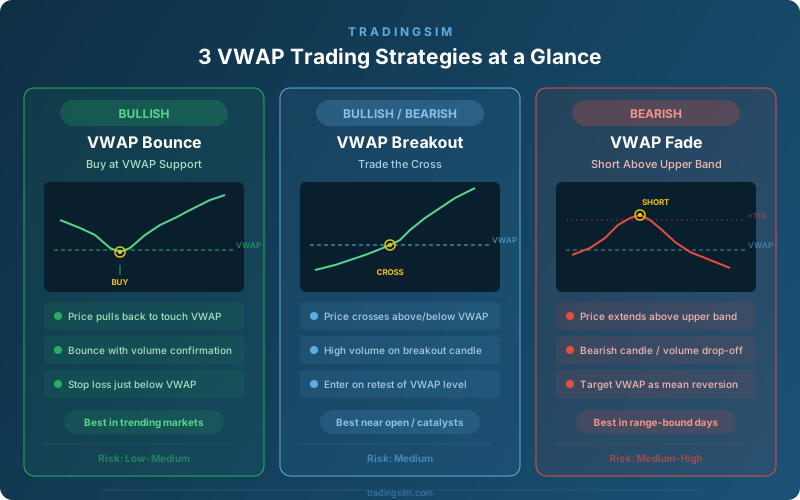
Now that we understand the VWAP meaning, the tools, and the legends who use them, let’s get tactical. Here are five specific strategies used by proprietary traders to extract profit from the market.
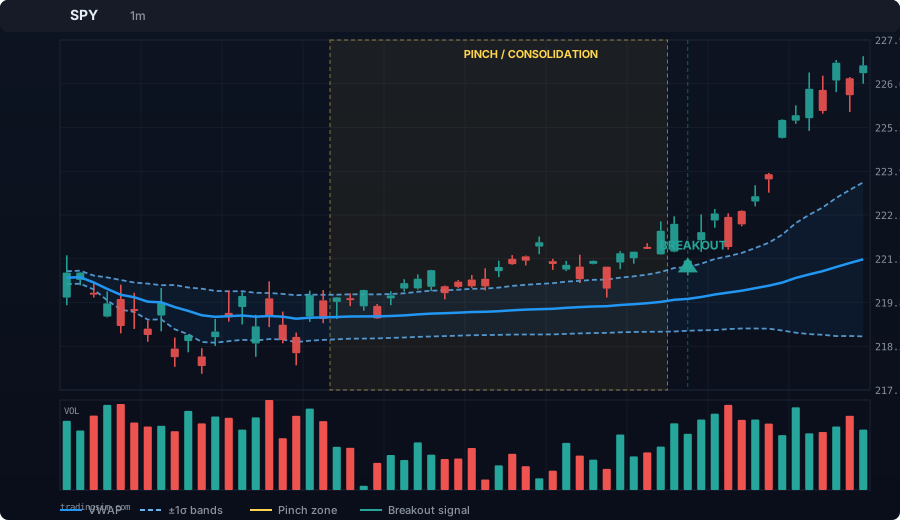
Strategy 1: The “VWAP Pinch” (Volatility Squeeze)
The Context: This strategy works best on late-day breakouts (after 2:00 PM EST). It relies on the concept of volatility contraction.
The Setup:
- A stock trends up in the morning on high volume (Morning Drive).
- It enters a consolidation phase during the lunch hour (11:30 AM – 1:30 PM), forming a sideways channel.
- Volume dries up significantly.
The Mechanism: As the price moves sideways, the rising VWAP “catches up” to the price. The price action gets “pinched” between a horizontal resistance line and the rising VWAP support.
🔥 The Trigger: A volume spike as price breaks above the horizontal resistance. This is your “Go” signal.
The Logic: The “average” price has risen to meet the current price, resetting the “overbought” condition. The pinch forces a decision, and the breakout usually follows the path of least resistance (the original trend).
Strategy 2: The “Institutional Reversion” (Fade Trade)
The Context: A parabolic move on a news spike. The stock has gone “vertical” and is disconnected from reality.
The Signal: Price hits the 3rd Standard Deviation band.
The Confirmation: A long wick candle (Shooting Star or Hammer) forms, indicating rejection at the extreme. This shows buyers are exhausted and profit-taking is beginning.
The Trade: Enter a Short position on the break of the rejection candle.
- The Target: The central VWAP line. (The “Mean”).
- Stop Loss: A close above the high of the rejection candle.
Strategy 3: The “Band-Walk” (Trend Following)
The Context: A strong trending day (e.g., NVDA or TSLA after a product launch). This is when you should NOT be fading the move.
The Signal: Price pushes through the VWAP and refuses to close back below the 1st Upper Standard Deviation Band.
The Psychology: Aggressive buyers are stepping in every time the price dips slightly, refusing to let it return to “fair value.” They are front-running the VWAP algorithm.
✅ The Trade: Buy the dip to the 1st Band (not the VWAP). The Exit is when the candle closes back inside the VWAP zone.
Strategy 4: The “VWAP Disaster Drill” (Short Setup)
The Context: A stock that is gapping down on bad news (Earnings Miss, FDA Rejection) but tries to rally at the open.
The Setup: The stock rallies up to the underside of the VWAP. This is often called the “Dead Cat Bounce.”
The Trigger: The price touches the VWAP and immediately rejects, printing a large red candle.
The Logic: “Bag holders” who bought yesterday are using the rally to get out at breakeven (or close to it). This supply overwhelms the demand. The VWAP acts as a ceiling.
The Trade: Short the rejection. Target the pre-market lows.
Strategy 5: The “Earnings Gap” Anchor (The Qullamaggie Setup)
The Context: A stock gaps up 10%+ on massive earnings volume. This is often referred to as an “Episodic Pivot” by famous swing trader Kristjan Kullamägi (Qullamaggie).
The Setup: Place an Anchored VWAP on the first 1-minute candle of the gap day.
The Trade: For the next 3-5 days, any pullback to this Anchored VWAP line is a buying opportunity.
💡 The Logic: Institutions that missed the initial gap entry will leave massive limit buy orders at the “Average Price” of the gap day to build their long-term position without chasing price.
Part 8: Identifying Market Interest (The Search Volume Clue)
A technical setup is only as good as the interest in the asset. If nobody is watching the stock, the VWAP levels won’t hold. We need to know where the crowd is looking.
This is where understanding search volume and Relative Volume (RVOL) becomes critical.
How to trade it:
Traders should constantly scan for stocks with high Relative Volume. When you see a stock with 2x or 3x its normal volume (or search interest spiking for a specific ticker), it confirms that “the herd” is present. VWAP works best when the herd is active because it creates the self-fulfilling prophecy of support and resistance.
🔥 The Rule: High Relative Volume + Price holding above VWAP = High Probability Long.
Part 9: The Psychology of “Fair Value”
Why do retail traders lose money trading VWAP stocks? It usually comes down to psychology. Understanding the mental game is just as important as the math.
The “Cheap” Trap
Retail traders love to buy stocks that have fallen significantly. They see a price far below the VWAP and think, “It’s cheap! It has to revert.”
Institutional Reality: If a stock is trading significantly below VWAP on increasing volume, it isn’t “cheap”—it’s broken. The market is actively repricing the asset lower. Buying here is like standing in front of a freight train. Institutions are unloading, and the high volume confirms they want out at any price.
The “Expensive” Fear
Conversely, retail traders are terrified to buy a stock that is trading at the 2nd Standard Deviation band. They think, “It’s too expensive, I missed the move.”
Institutional Reality: In a momentum market, “expensive” stocks often get “more expensive.” If volume is sustaining the move, the VWAP will rise to meet the price, validating the new valuation. The “Band Walk” strategy we discussed earlier exploits exactly this fear.
🧠 Key Takeaway: VWAP is not just a support line; it is a sentiment gauge.
- Price > VWAP = Bullish Sentiment (Buy Dips)
- Price < VWAP = Bearish Sentiment (Short Rallies)
Part 10: VWAP vs. The World (Indicator Comparison)
How does the VWAP indicator stack up against other popular tools? Is it really superior?
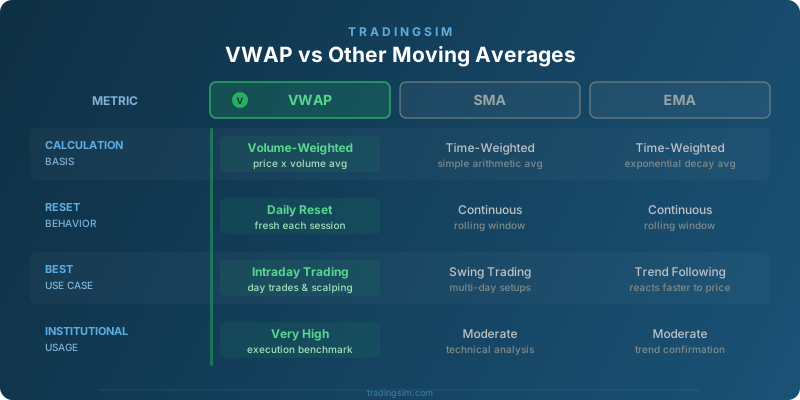
| Indicator | How It Works | The VWAP Advantage |
|---|---|---|
| Simple Moving Average (SMA) | Averages Closing Price only. | Volume: SMA ignores volume. A 1-share trade affects the SMA as much as a 1M-share trade. VWAP fixes this flaw. |
| Exponential Moving Average (EMA) | Weights recent prices heavier. | Intraday Precision: EMA is great for trends, but VWAP provides the definitive “Fair Value” for the current trading session. |
| Bollinger Bands | Uses Standard Deviation on SMA. | Anchoring: Bollinger Bands float based on a lookback period (e.g., 20 days). VWAP Bands are anchored to the open, providing a fixed “session” context. |
| RSI (Relative Strength Index) | Measures momentum speed. | Price Levels: RSI tells you if a stock is overbought. VWAP tells you exactly where (at what price) to short it. |
Part 11: How to Practice VWAP Without Risking a Dime
Reading about VWAP calculation and strategies is like reading about weightlifting. You don’t get strong until you lift the weights.
The hardest part of VWAP trading is trusting the bands when the market looks scary. When a stock is crashing toward the 3rd Deviation Band, your brain will scream “SELL!” but the strategy screams “BUY (for a scalp).”
This is where Tradingsim serves as your flight simulator. You need reps. You need to see 100 VWAP bounces before you risk real capital.
✅ Your Practice Checklist:
- Load the Data: Open Tradingsim and load the Nasdaq 100 (NQ) futures or a volatile stock like NVDA.
- Configure the Tools: Turn on the VWAP and enable Standard Deviation Bands (Set to 2.0 and 3.0).
- Hide the Future: Use the “Market Replay” feature to hide the right side of the chart.
- Simulate: Fast forward to the market open (9:30 AM).
- Drill 1: Identify the first test of the VWAP. Did it hold or break?
- Drill 2: Wait for a “Band Walk.” Try to add to your position on the 1st deviation band.
- Drill 3: Execute an “Institutional Reversion” trade when price hits the 3rd band.
- Review: Did the price revert? Or did the trend continue?
Conclusion: Your New “Fair Value”
The VWAP is the great equalizer. For decades, institutional desks used their superior technology and order flow information to dominate the market. The VWAP indicator levels the playing field.
It allows independent traders to see the same “fair value” lines that the algorithms are defending. It transforms a chaotic chart into a structured roadmap.
By combining the classic VWAP with Standard Deviation Bands and Anchored VWAP, you aren’t just looking at lines on a chart—you are reading the psychology of the market participants.
The market is a battle between value and price. VWAP is your map to the battlefield.
Ready to start your training? Start your free trial on Tradingsim today and see if you can spot the next Institutional Reversion before the rest of the market catches on.
Key Research & References
- Almgren, R., & Chriss, N. (2000). “Optimal Execution of Portfolio Transactions.” Journal of Risk. (The foundational math on VWAP execution trade-offs).
- Boyd, S., et al. (2011). “Optimal Execution of Portfolio Transactions.” Stanford University Engineering.
- Madhavan, A. (2002). “VWAP Strategies.” Journal of Trading. (Detailed breakdown of institutional execution costs).
- Shannon, B. (2008). Technical Analysis Using Multiple Timeframes. (The seminal work on Anchored VWAP).
- Elkins, J. (1984). Origins of VWAP at Abel Noser Corp.
- Glick, K. (2020). “The Warlock’s Journal: VWAP Trading Methodologies.” (Interviews and strategy breakdowns).
- Kullamägi, K. (2021). “Episodic Pivots and the Earnings Gap.” (Swing Trading Masterclass).


