
Mike Woo is back as an ethics watchdog for L.A. County
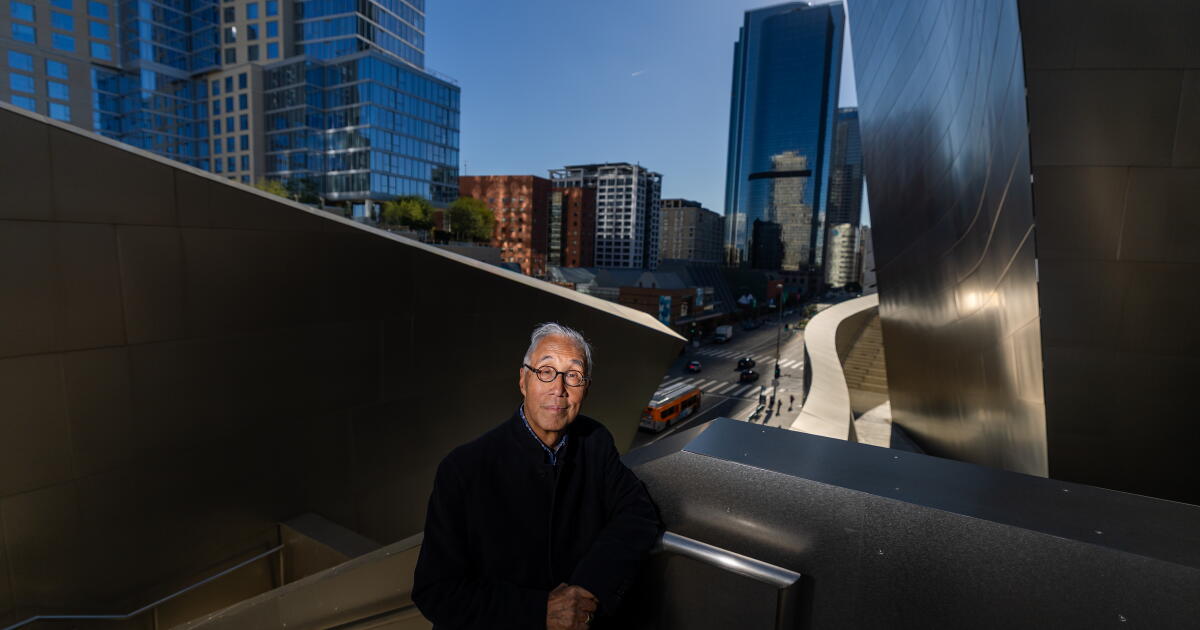
Nearly four decades ago, a young Los Angeles City Council member named Michael Woo played a pivotal role as the city dug into an ethics scandal involving Mayor Tom Bradley. In the end, Woo would spearhead the effort to create the city’s first Ethics Commission.
Today, Woo is again involved in ethics reform, though this time it involves the County of Los Angeles, and the impetus is not a percolating scandal, but rather a voter-approved charter amendment. Woo in September was named one of the initial three members of an ultimately seven-person commission with duties that include overseeing and enforcing county laws relating to campaign finance, lobbying, conflicts of interest and more.
“I love new challenges, and I feel as if I have a lot of energy,” Woo, sporting a cheery demeanor and round glasses, said on a sunny afternoon at a cafe in Atwater Village. “When I heard about this commission, it made me think that maybe I can play some role here.”
Woo, 75, was selected for the post by the Governance Reform Task Force, a panel advising the county on how to institute the reforms spelled out in Measure G, which voters passed in 2024 and which also included an expansion of the county Board of Supervisors and the creation of a new county executive seat. Some 370 people applied for spots on the commission.
Sara Sadhwani, the chair pro tem of the task force and chair of its ethics ad hoc subcommittee, said factors in selecting Woo included his public service record. She added that he “fundamentally understands the kinds of reporting and conflict-of-interest issues that can arise for those in positions of public trust.”
The three appointees have been busy, as they recently sifted through applications to identify the four people who will join them on the panel. The Board of Supervisors is expected to consider the nominations on Dec. 1, and soon after the full county Ethics Commission will hold its first official meeting. Commissioners receive $250 per meeting.
Settling in Silver Lake
Woo grew up in the Crenshaw district before his parents became one of the first Chinese families to move to Monterey Park. His father ran a produce business where his mother worked as a bookkeeper. In 1962, his father helped co-found Cathay Bank, at a time when, Woo says, “there was no Chinese-owned bank” in Los Angeles.
Woo attended UC Santa Cruz, then earned a master’s in city planning from UC Berkeley. He moved to Silver Lake in 1980 and bought a home in the neighborhood three years later; he still lives there with his wife of 24 years, Laurie Dowling, the executive director of a trade association that promotes diversity in the utility industry. They have “a very rambunctious” Dalmatian named Romeo.

Los Angeles Councilmember Peggy Stevenson in 1985.
(Los Angeles Times)
Woo lost his first run for the City Council’s 13th District to Peggy Stevenson in 1981 but defeated her four years later.
In 1989, reporters learned that Bradley, who had been mayor for 16 years, was quietly being paid as an advisor to two Los Angeles banks, including one that was doing business with the city. It was an ethical if not a legal breach.
Woo was an unlikely figure to play a central role in the proceedings. As a junior council member, he chaired the council’s Governmental Operations Committee, a second-tier panel that had jurisdiction over rules and other matters.
“It was a very awkward and tricky situation,” Woo recalled of looking at the activity of a political giant. “Tom Bradley was part of the firmament.”
The committee investigated the proceedings, but, Woo recalled, Bradley got in front of the matter and created his own blue-ribbon commission to consider all manner of reforms. The parties came together and settled on a series of proposals.
“Since I was the chair of this little-known committee, it fell into my lap to try to, No. 1, get it approved by the City Council, and No. 2, put together a ballot campaign, to get voter approval.”
Measure H passed in 1990, instituting a raft of reforms including public financing for political campaigns, prohibiting outside jobs for elected officials, and establishing the city Ethics Commission. The ballot language included raises for elected city officials, which Woo recalls was a key reason for the council backing the plan.

Avid reader Michael Woo in the 1990s.
(Al Seib/LA Times)
Run for mayor
Three years later, Woo ran for mayor. He finished second in a 24-person primary that included multiple members of the City Council. He lost a bitterly fought runoff against Republican businessman Richard Riordan in what at the time was the city’s most expensive mayor’s race ever.
“It was probably the most exhausting and the most exciting experience I have ever had,” Woo recalled. “I learned a lot about the city.”
Out of office, he moved into academia, with a series of positions, including serving as dean of Cal Poly Pomona’s College of Environmental Design from 2009 to 2019. He continues to teach at USC.
He also has kept a hand in the nonprofit and civic sphere. He served on the City Planning Commission from 2005 to 2012, and for the last four years has been the unpaid volunteer president of the 1871 Memorial Project, a group working to remember the Chinese Massacre in Los Angeles. It started on an October evening in what was then known as Calle de los Negros, which was the center of L.A.’s first Chinatown, when a fight resulted in a police officer and a white rancher being shot. Rumors blamed the violence on the nascent city’s Chinese population. Eighteen Chinese people were killed.
Woo acknowledges that he didn’t know about the dark moment in L.A.’s history for much of his life. He worked with 1871 Memorial Chair David Louie on the effort that has raised funds and selected designs for a multi-site memorial; the first phase, near Los Angeles and Olvera streets, is scheduled to debut next year.
“What’s remarkable about Michael is that public service isn’t just something he used to do,” Louie said via email. “It’s who he is.”
Louie added, “He listens carefully, respects different viewpoints, and approaches difficult decisions with fairness, thoughtfulness and integrity.”
Looking ahead
Although Measure G was approved two years ago, fully codifying an independent Ethics Commission, and creating a county Ethics Compliance Office that will handle day-to-day operations, required additional charter tweaks. Those were laid out in Measure E, which was passed overwhelmingly by county voters on Nov. 3.
The office will be established in phases through 2028, and the search for an ethics compliance officer, who will oversee a staff of 55 to 60 people, is on. The publicly posted job will pay up to $347,424.
Whereas Woo in 1980 worked to establish the city Ethics Commission, then took a back seat as it was formed, this time around he will help build and define the county panel. Sadhwani expects that the scope of Woo’s career will help the commission be impactful.
“One of the core tenets that we enshrined in the Ethics Commission language in Measure E is that the commission takes seriously an education role, both for the general public, but also for those in public office, as opposed to being purely punitive,” she said. “There is strong hope that Mr. Woo’s former service, but also his role as an educator, will aid in that mission.”
County Supervisor Lindsey Horvath, an architect of Measure G, also believes the commission and ethics office can play an important education role, including for newly elected leaders. At a recent Los Angeles Current Affairs Forum event, she said that when she first won a West Hollywood City Council seat in 2009, “there was no binder, there was no training.”
She believes accountability can dovetail with education and benefit elected officials and the general populace, so that “we’re all educated about what the rules of the game are, and that we should be playing by them accordingly.”
Woo, whose current hobbies include drawing comics (he posts some work on Instagram), ticks off a litany of things to learn and potential areas of focus for the commission. These include exploring how ethical standards are applied to county contracting; campaign finance; and special interest involvement in races for county executive and other posts.
Success, he says, will require not just enacting reforms, but being able to adjust those as necessary. Combating conflicts of interest and outright corruption is a long-term play.
At the Atwater Village cafe, he reflected on something he said when he was being considered for the post.
“I felt that political corruption is like a virus that adapts to antibiotics that are being used against it,” he said, “and that anti-corruption efforts also have to be adaptable.”


