
D.A. won’t charge LAPD officer who shot mentally ill man in Koreatown
Prosecutors have declined to charge a Los Angeles police officer who shot and killed a knife-wielding man in his parents’ Koreatown apartment more than two years ago, a case that cast a spotlight on police interactions with people who are mentally ill.
Citing insufficient evidence of criminal wrongdoing, the Los Angeles County District Attorney’s Office concluded that the officer, Andres Lopez, reasonably believed that his life was in danger when he fired three rounds at Yong Yang, who ignored repeated commands to drop a knife.
The decision was swiftly condemned by Yang’s family, which has filed two separate lawsuits — in federal and county courts — contending that their son’s death was preventable and caused by police’s unwillingness to consider other options before resorting to deadly force.
The city has denied wrongdoing in both suits, which remain pending.
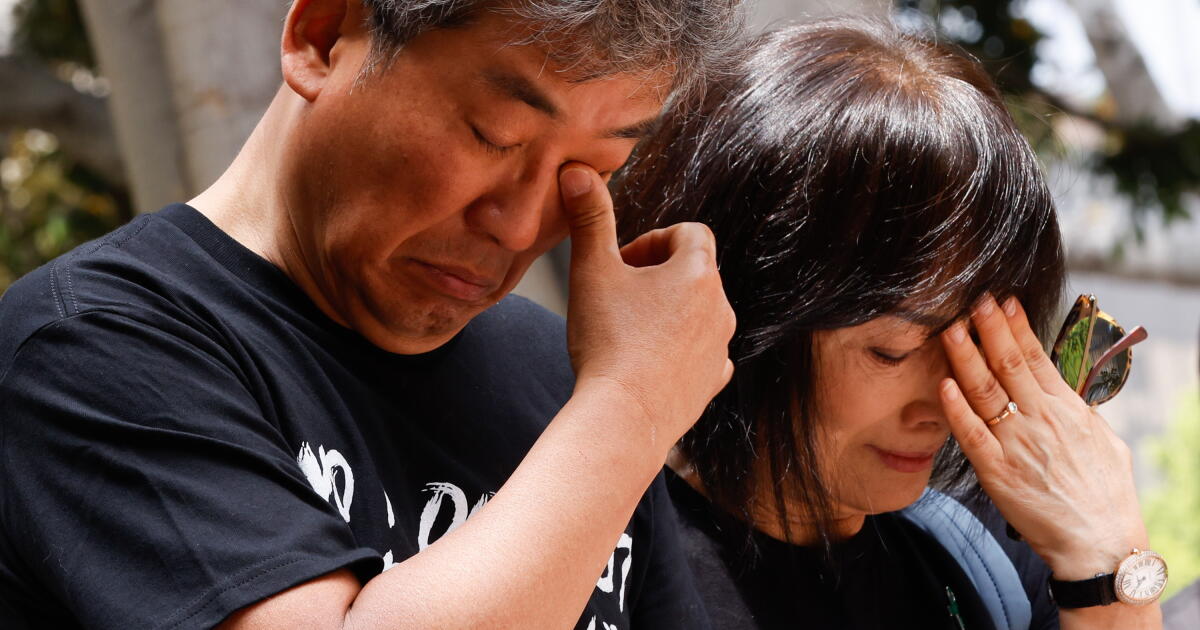
In a statement released Friday, Yang’s father, Min Yang, said he was “deeply disappointed” by Dist. Atty. Nathan Hochman’s office. He said the charging decision was based on “inaccurate” conclusions about what happened in the incident.

A relative holds a photo of Yong Yang, 40, who was shot and killed by an LAPD officer during a mental health crisis inside the family’s apartment.
(Genaro Molina / Los Angeles Times)
The D.A.’s report copied, almost verbatim, from parts of LAPD’s own internal review of the incident, the father said.
“Both agencies could have uncovered the facts had they chosen to do so,” Yang said.
The deadly encounter with Yang in May 2024 began after his mother called the county’s psychiatric emergency response team for help. The clinician who arrived at the family’s second-story apartment in the 400 block of South Gramercy Place claimed Yang’s behavior became too aggressive and requested police.
In their lawsuit, Yang’s parents dispute that their son tried to harm his father or the clinician, and denied that Yang was diagnosed with schizophrenia. They also took issue with Yang being labeled as “violent,” saying that designation provoked a far more aggressive police response.
They also claimed that the clinician took only a few minutes with their son before calling for police.
According to a report prepared by the LAPD chief, Lopez and his police partner were the first two officers on the scene. Body-worn camera footage released after the shooting showed them talking with Yang’s father and explaining their options to him, including whether to put Yang on a 72-hour mental health hold.

The cops tried to talk to Yang, but he had locked himself inside the apartment and refused to open the door. Eventually, the police requested backup and called a private ambulance to transport Yang to a nearby hospital.
After some deliberation, officers decided to enter the apartment. Upon opening the door, they found Yang standing in the middle of the living room with a kitchen knife in his hand. He began walking toward officers, who shouted at him to drop the knife before Lopez opened fire, shooting three times in less than two seconds.
Lopez could still face discipline for his tactics leading up to the shooting, which the department’s civilian oversight body previously concluded violated department policy. But he is unlikely to face serious punishment after the same body, the Police Commission, ruled that he was justified in using deadly force.
Lopez, who joined the LAPD in 2017, previously fired his weapon in 2021 when he shot and wounded a 35-year-old man who was carrying a replica handgun outside of the Olympic Division police station. That shooting was also found to be in policy.
Yang’s parents have filed a wrongful death lawsuit against the city, contending that the officers had other options available — including so-called less-lethal weapons — but failed to exhaust them before resorting to deadly force.
Yang’s family has disputed several details about the case as described by police. They denied that Yang had physically assaulted or threatened his parents and said that he “did not kick his parents out of their apartment” as authorities previously said and several news outlets reported.
But prosecutors argued that some of the parent’s comments were contradicted by their previous statements to LAPD investigators and by body-camera footage. The report says that Hochman met with Yang’s relatives on several occasions in the months leading up to the decision. But, the report claimed, Yang’s parents declined to meet with prosecutors for interviews in late August, after the family’s attorney sent a letter “disputing certain details” about the case.
In a brief interview Friday, Hochman said that although Yang’s shooting was tragic, his office could not prove beyond a reasonable doubt that it was criminal.

Protesters stand during a vigil for Yong Yang outside Los Angeles City Hall in May, two years afters he was shot to death by an LAPD officer.
(Carlin Stiehl / For The Times)
After police attempts to diffuse the situation failed, Yang’s unwillingness to drop the knife and instead advance toward officers left the officers on the scene without other options, Hochman said.
LAPD officials have said the department has made numerous changes in recent years to curb police shootings, including adopting deescalation training focused on slowing down volatile situations, particularly those involving people who may be mentally ill. Still, the agency’s critics pack police commission meetings each week to argue for removing police from such calls, saying that officers are too quick to fire on people — particularly those wielding knives.
Although the city has experimented with programs that send specialists to help deescalate such encounters, LAPD policy still requires armed patrol officers to clear a scene of any potential threats beforehand.
Hochman said that he was aware of the contentious debate around the LAPD’s response to such incidents, but said he believed that in this case, police went to some lengths to try to avoid using deadly force.
“This is Exhibit A for what all the people who want a non-police response are looking for,” he said. “The problem here is that it actually ended tragically.”


