
🇰🇷 Korea Trip Report – Emerging Market Skeptic

I have finally gotten to writing a detailed trip report covering my first visit to Korea late last Spring as I had frequent flyer miles on China Airlines (TPE: 2610) to use up (meaning a long stopover in Taipei). I have pretty much been everywhere in SE Asia plus Sri Lanka along with many places in China and especially Taiwan (from doing multi-day stopovers); but hadn’t yet visited Japan (until a few years ago) or Korea.
My perception of both countries was that it would be difficult to get around (the language & writing barriers) and expensive to stay for at least a few weeks. Bear in mind that I have found travel in China to be fairly easy (thanks to the Pinyin writing everywhere along with Ctrip) e.g. I travelled all over the former Manchuria from Dalian to Harbin before COVID where not many Western tourists go.
I did some previous trip reports covering the first time I had travelled around Japan (tourist filled Tokyo & Kyoto) which turned out to be relatively easy and not particularly expensive (the Yen was also at a record low at around Y150 to US$1):
I have to say that I was blown away by Korea and even my parents commented that it looked like one of the nicest places I had been to based on the pictures I took.
While nothing compares to Kyoto (you need at least a month there to see everything), Seoul has far more interesting things to do (that are often free e.g. museums, etc + very very helpful tourism offices/kiosks everywhere) than Tokyo while Busan is absolutely spectacular – easily ranking with San Francisco, Cape Town or Rio de Janeiro for it’s natural setting alone. Even Seoul has a somewhat nicer natural setting (a river with mountains both inside and surrounding the city) than Tokyo.
I would dare say that if you had to choose, Seoul/Busan are a must visit over or at least before visiting the rest of Japan (and Korean food is incredible).
The rest of this post will be divided into two posts so that the trip report portion (mostly a travel rather than stock report) can be left un-paywalled (to be commented on by anyone with other travel tips) and the stock portion (partially paywalled). It is organized as follows (and after publishing, I will replace the text below with the autogenerated table of contents that also appears on the left side of the screen on desktop browsers):
[Note: On desktop browsers, an autogenerated table of contents will appear on the left side linked to each stock. I will add those links below after publishing/emailing this post…]
-
-
-
-
Binggrae Co Ltd, Bohae Brewery Co Ltd, CJ Cheiljedang Corporation, CJ Corp, CJ Seafood Corp, Crown Confectionery Co Ltd / Haitai Confectionery and Foods Co Ltd / CrownHaitai Holdings Co Ltd, Daesang Corp, Daesang Holdings, Dongwon F&B Co Ltd, Dongwon Industries Co Ltd, HiteJinro Co Ltd, HiteJinro Holdings Co Ltd, korea Alcohol Industrial, KT&G Corp, Lotte Chilsung Beverage Co, Lotte WellFood Co Ltd, NongShim Co, Orion Corp, Otoki Corp, Pulmuone Corporate, Samyang Foods Co Ltd & Wooyang Co Ltd
-
Readers can decide whether these insights or summary about these stocks are accurate:
When “analysts” talk about Japan, Korea and China, they often dwell on the demographic challenges. When I visited Tokyo/Kyoto a few years ago, there were plenty of people, including young Japanese/kids and occupied high rises everywhere (but not so much new construction).
However, there seemed to be a bit more new construction in Korea (Taipei construction has also noticeably picked up) post-covid and no doubt due to the AI boom. There are also reports of foreigners buying Korean property (although some curbs have been put in place to stop speculation in Seoul) e.g. Chinese, Taiwanese and Koreans abroad (as American and Canadian cities deteriorate and become too expensive to retire in) and probably foreigners married to Koreans.
Like Tokyo/Kyoto and when you travel between these cities by train, Korea does not look or feel depopulated (maybe because it looks a bit rugged with fewer building spaces) when in or traveling between Seoul/Jeonju/Busan. And despite plenty of social media chatter about the so-called 4B movement (a radical feminist movement whose proponents do not date, marry, have sex with, or have children with men), you will see many young men in uniform doing their military service along with couples, children and people of all ages.
One thing that was noticeable was how many older people are still working (and not yet replaced by foreigners) and how many of them are badly hunched over – this was something that actually got discussed at a hostel I stayed at. I am 6’4’’ and walk fast. I very nearly walked into an elderly Korean so hunched over that she came up to my stomach and I only saw her at the last second! Others staying at the same hostel (including a half German/Egyptian girl studying in Korea who was close to my height) also had similar near misses!
As amusing as this was, this now elderly Korean generation has sadly suffered the most. First under the Japanese occupation and then the Korean War and its aftermath. Then they had to sacrifice to rebuild the country and turn it into the industrial/tech powerhouse it is today only to be hit by the Asian Financial Crisis. Many may not have children who are in position to help them much and they are thus forced to continue working or must scrap by on limited pensions and retirement savings.
With this said, I have commented in the past on other Substacks (e.g. Rei Saito’s KonichiValue Japan which has good coverage of Japan’s demographic problems) that I think the hyperventilation over population declines is “capital” panicking that native born workers will gain leverage over capital to, god forbid, demand better compensation and benefits. And god forbid should asset and specifically housing values not continue to inflate so Blackstone or older boomers lose out on massive capital gains and young families can afford to buy them (instead of being childless renters in tiny apartments). Then you have companies like Wal-Mart who will see their earnings take a hit if the population is not growing and if they can’t hire cheap foreign labor.
But as awful as the Black Death was in Europe, it also made land available to peasants and raised their standard of living which led to more prosperity for them (and leverage over the nobility) and ultimately to the population growing again (enough to populate colonies and create new nations all over the world). The main problem with population declines will be maintaining necessary and unnecessary infrastructure in areas where the population has rapidly declined.
Note that Korea has been able to address this in certain former coal mining districts that now have casinos and other attractions in them for tourists. Otherwise, Koreans are still being drawn to Seoul, Busan and probably a handful of other key cities.
However, this recent tweet and the comments that accompanied are also interesting:

Sadharan Varma@JohnSmithmvlw
Japan is really unique among 1st world nations, as anyone can get a job if they want one. If you graduate from a university then you can become a salaryman where you get taught everything, if you were terrible at studying you can go to a trade school and get a skilled blue collar…

Polymarket @Polymarket
JUST IN: Young South Koreans are increasingly moving to Japan for work, as graduates struggle to find jobs at home. — Reuters
3:13 AM · Aug 3, 2026 · 2M Views
103 Replies · 1.09K Reposts · 19.7K Likes
I suspect if Koreans are moving to Japan in large or at least noticeable numbers, its due to a lower cost of living there or at least in Tokyo (due to zoning laws encouraging more housing) vs. Seoul:

PocketMagnifier@MagnifierPocket
@JohnSmithmvlw I suspect the relatively cheap housing is a large part of this – since Tokyo zoning (I assume the rest of Japan) is by-right if it’s below a certain nuisance level and land plots are easily subdivisable, it leads to cheaper housing.
Please correct me if I’m wrong though
1:38 PM · Aug 3, 2026 · 68.2K Views
4 Replies · 6 Reposts · 227 Likes
Sadharan Varma@JohnSmithmvlw
@MagnifierPocket Yeah rents in Japan are cheaper than in other 1st world countries, partly because of zoning, partly because houses aren’t seen as investments.
That helps a lot when you are young, you can move out relatively easily.
1:46 PM · Aug 3, 2026 · 56.6K Views
2 Replies · 5 Reposts · 228 Likes
However and earlier this year, Rei Saito (KonichiValue Japan) made this reply to a comment of mine on a post of his (What happens if Japan takes in zero…) containing these interesting observations about the differences between Korea and Japan:

Note that when I lived in Manila almost two decades ago, there were an estimated 100,000 or more Koreans living in the Philippines and in Cebu in particular. Koreans would come to the Philippines because it was cheap to go there on vacation, play golf, retire, or to learn English plus the weather was warm, its a reasonably short flight, and the visa policies are relaxed. Then they would start small businesses that often catered to the Korean community or Korean visitors.
Many of these Koreans, I guess, were from the working or lower classes (as I knew a Dutch businessman married to a Korean who said his wife was embarrassed by the ones there – she was probably from the upper or more educated classes…). They were moving to the Philippines as I guess they found living the more relaxed pace of life and starting small businesses there to be easier or requiring less capital than doing the same in Korea.
However, the Filipinos seemed to feel that Koreans looked down on them. Maybe they do but it may also be due to Korean culture (and the language barriers) being so different from Filipino culture that it was harder for them to integrate or mix (despite the Philippines being a melting pot) as they usually formed their own Koreatown enclaves (although Korean churches were apparently making headway by distributing food to the poor). I only remember briefly encountering one Korean married to a local Filipina (he had an internet cafe type of business outside Manila); but that doesn’t mean there wasn’t more intermarriage.
But Koreans did seem to be everywhere e.g. I was surprised when on a mountaineering club trip to Mindanao and we walked through a clothing market in Cagayan de Oro, it was almost all Koreans sitting on chairs on platforms above the clothes where they handled the money (while any Filipino staff handled the clothes and customers) with I think Korean music playing.
According to a resort operator quoted in a 2005 article [[Liberal Times] ‘Korean Wave’ in Philippines], “Koreans are not so sensitive to bad news in the Philippines” (and there is always bad news about the Philippines and Mindanao in particular…). However, Wikipedia’s Koreans in the Philippines says:
As of 2013, statistics of South Korea’s Ministry of Foreign Affairs and Trade recorded their population at 88,102 people, a fall of 31% since 2009 after a period of rapid growth in the population in the preceding decade.[2][4]
The numbers being down may also be due to Koreans coming and living on tourist visas for extended periods of time (something that can still be done in the Philippines); but not necessarily full time.
One other point I should note: When I did headhunting in Vietnam, there were many Korean companies operating there; but local professionals did not want to work for them because they were absolutely notorious for being cheapskates when it came to paying locals (and I am sure they also had demanding work expectations for staff). Not that many western MNCs were much better when it came to pay; but they could sell themselves for the training and “career growth” opportunities and being “better managed” than local companies. Korean companies could not…
As with Japan, late Spring and early Fall are probably the best times to visit Korea – especially weather-wise. Unless you are into skiing, winter would be far too cold to do much outdoor sightseeing while Summer might be too hot and probably humid.
I went late April to around May 20th and the temperature ranged between 40-90 degrees. The weather on my last day was actually the worst as it was a steady chilly drizzle and I did not want my shoes getting soaked before my flight.
Otherwise and when I arrived, the Chinese fringe trees, rhododendrons, azaleas, etc. were in full bloom and there were still blooms in the various gardens/parks I visited until I left:


Aside from weather considerations:
K-Royal Culture Festival. In addition to daily changing of the guard ceremonies at certain palaces, this is a biannual cultural heritage event held at Seoul’s five royal palaces (Gyeongbokgung, Changdeokgung, Deoksugung, Changgyeonggung, Gyeonghuigung) and Jongmyo Shrine. The spring edition was late April to early May when I was there while the fall edition is in early October.
I saw plenty of free cultural performances at the palaces (plus there were other cultural activities that required reservations); but I missed out on performances at night as you need to make ticket reservations for those months in advance. Some of those performances are also reserved for foreigners to promote Korean culture.
Yeon Deung Hoe (Lotus Lantern Festival) Parade. Lately, I have been walking in Kuala Lumpur’s annual Wesak Day procession that winds through the city. However, Korea’s version is on an entirely different level with easily 100,000 people taking part with lotus lanterns or on floats on the Saturday before Buddha’s Birthday (May 16 when I was there):
The procession route begins at the Heunginjimun Gate (Dongdaemun), travels along Jongno Street and ends at Jogyesa Temple. It typically starts at sunset (around 7:00 PM) and lasts for two or three hours.
Note that the route is lined by rows of plastic seats with plenty of sections not reserved. However, you will need to come early to grab one (maybe a good 2 hours early to potentially sit in the sun) and it will be easier to get one away from the start/finish, MMCs/announcers/TV cameras and probably subway stations. Be mindful that the closer you are to the finish point, the longer it will take for the procession to reach you (but it will be darker by the time most of it does):
The procession had a bit of everything – including these robots:


Labor Day (May 1) and Children’s Day (May 5). This ended up being a five day weekend in 2026. I had pre-booked all my accommodations and train from Seoul to Jeonju some weeks in advance. If trying to stay at nice hostels in North/East Asia on a weekend or holidays, you should always book a good month in advance to ensure accommodations as that’s when young locals travels (you might be able to still book rooms in better quality hotels at the last minute, but don’t expect any discounts).
There were guests at the hostel I was staying in Seoul who had not anticipated there would be no accommodations available anywhere during this time and they were scrambling to find an alternative (e.g. leave the city for someplace people weren’t traveling to, etc.).
Although I am certain its not at the level of traveling to places like Russia and Iran, using non-Korean cards and payment methods in South Korea or on Korean sites was a surprising headache (and no doubt a testament to the power of local financial institutions). It was a much bigger headache than even booking highspeed train tickets before visiting China (I think I used Ctrip the last time) or Japan.
However, I am not so sure about China these days (as I have not visited there since just before COVID); but I have heard the steady march towards using Wechat and other non-cash payment methods in the big cities is causing difficulties for foreign and no doubt American tourists (as its difficult for foreigners to get these accounts set up; but supposedly they will try to make it easier).
On my last trip to China before COVID, I had to give a Chinese friend studying in Malaysia a US$100 bill and he used his Wechat to make me an advanced booking on the overnight Cosco Star Ferry from Keelung (Taiwan) to Xiamen (China). When I went to the Cosco office in Taipei to double check everything had gone through, they had to Wechat with someone China to confirm my name was on the manifest.
For Korea:
Korail: I needed to pre-book three tickets on Korail (Seoul-Jeonju-Busan-Seoul) weeks in advance (you can do it up to 30 days in advance while services like Klook do pre-sales beyond 30 days) and every time I hit pay using my a Visa card from a US bank, a hold was placed on it. I would then have to call Visa, get the hold lifted and then redo the booking and transaction.
ATMs: ATM machines were hit or miss. The only ATM card I have and use is from a US credit union and I am not sure if it even works abroad anymore. So I had to take cash advances from my Visa card.
However, I had to go to a couple of machines at the airport upon arrival as I was getting the following error:
“IC chip cannot be read. Use another Card.”
It was also hit or miss at non-airport machines. However, I had no problems when the card was run through to buy souvenirs and for one small entry fee.
T-Card. Like Easycard in Taiwan, Korea’s T-Card (or T Money Card) is Korea’s primary rechargeable prepaid transportation card for paying fares on subways, buses, taxis and at convenience stores. The card costs a couple of thousand Won or a few dollars at the airport or Metro stations and is a must have. Note that there are apparently other cards available for tourists in Korea; but you need to ensure they have Tmoney functionality to make them useful or have them work on local transportation.
I was topping mine up with small amounts of Won nearly everyday and its also a good way of “getting rid of” small change that inevitably start to overflow from your wallet and pockets when paying cash (and I prefer to pay in cash as much as possible…).
One big warning to avoid headaches: Korean plugs or wall sockets are horrible for standard travel adaptors as it’s nearly impossible to get them to stay inside a circular Korean wall socket (especially when plugging a heavy computer adaptor into the travel adaptor). At various times, I was forced to put my backpack, a towel or my foot (on Korail trains) under my travel adaptor to keep it from falling out of the socket.
IF I had known that, I would have BOUGHT a Korean specific adaptor with me that would fit snugly into Korean wall sockets to avoid the headache of constantly fighting to keep something plugged in wherever I went.
And even if you are staying in a luxury hotel that has international plugs or adaptors, you will still be fighting with Korean plugs on Korail trains and if you go to coffee shops, etc., and need to plug something in. However, if the socket is in an adaptor on the ground (and not a wall socket), a normal travel adaptor should be ok (but still may not fit snugly inside).
Before going to Korea, you definitely want to download the KakaoMap app from Kakao Corp (KRX: 035720) and NAVER Maps app from NAVER (KRX: 035420 / OTCMKTS: NHNCF). I ended up mostly using NAVER Maps over KakaoMap for no other reason other than it was easier to stick with one along with Google Maps for the English which was less accurate (especially for bus/metro/train schedules).
In addition and a few months before visiting, I stopped by the Korea Tourism Organization’s nearby Kuala Lumpur office. Although generally staffed by locals, it was well stocked with brochures and they even gave me a free calendar.
In Korea itself, there are also small tourist information centers staffed by extremely well trained and knowledgeable English speaking staff everywhere in major tourism areas. Some of these staff are older Koreans e.g. I spoke in length to one at the Songjeong Tourist Information Center in Busan who told me he had travelled all over the world as I guess he was a retired manager/executive who wanted something to do in retirement (I am sure all staff are paid) and probably enjoyed talking to/helping foreign visitors. These centers are also well stocked with maps/brochures and tourist binders with more info on places less visited to warrant a brochure.
However, they would not always give the best route to a tourist site as they gave the route they thought would be easiest for a foreign tourist to take. But between them, NAVER (fairly accurate/update train and bus schedules) and Google Maps, I was able to figure out the best way that made the most sense for me to get somewhere without too many headaches.
Do note the following recent development:
📰 Google Maps wins access to South Korea — one of last countries where app does not work (FT) $ 🗃️ 27 Feb 2026
South Korea lifts data restriction that has prevented US tech group from providing navigation services
The rule, which also affects Apple Maps, has helped local rivals such as NAVER (KRX: 035420 / OTCMKTS: NHNCF) and Kakao Corp (KRX: 035720) dominate the market.
But Seoul has been under growing pressure to ease business obstacles after officials in Washington, including trade representative Jamieson Greer, accused South Korea of discriminating against US tech companies and threatened to raise tariffs.
The specific changes:
South Korea will allow Google to export 1:5,000-scale digital map data, in which each unit on a map represents 5,000 units on the ground. This will clear the way for improved navigation, driving and other location-based functions.
Previously, Google was restricted to using less-detailed 1:25,000-scale data, which significantly weakened its competitiveness against local rivals.
I was fairly familiar with the three major Korean convenience store operators or stocks BGF Retail (KRX: 282330) [CU brand], E-Mart (KRX: 139480) [emart24] and GS Retail (KRX: 007070) [GS25] as all have entered the Malaysia market with what I would call outlets that cater to the middle class, office workers and young people/students. Their Kuala Lumpur locations typically have indoor or outdoor seating along with interesting Korean food plus a steady flow of new products or specials – like a whole series of Ube products for October:

In addition, it seems like the Korean chains employ local Malaysians rather than Bangladeshi guest workers (meaning they are probably paying a premium for better quality staff).
In Korea, its a bit of a different story as many of the same convenience stores were noticeably downmarket and are probably employing people from the local working classes.
Quality in Korea was also different and varied. For example: On a couple of occasions (including twice in one night), I took a roll of kimbap to the cashier only to have it scan as being out of date. While I am glad that the scanner caught that, out-of-date Kimbaps should not have been available for sale and the “manager” (basically the person working the counter as some outlets were small enough to employ only one person) should be checking their RTE inventory a little better:
At least the kimbaps were a bit bigger in Korean than what they sell in Malaysia and they were quite varied. However, the problem for the Korean or any convenience store chains in Malaysia is that they are competing with mamaks and street hawkers. Their selling point is fast convenience (as made-to-order food in mamaks can take awhile) and food safety.
When I got back to Seoul from Busan, I discovered two local chains had outlets near where I was staying (as the area was mainly non Korean food like kebab shops, etc.) and stopped eating at convenience stores:
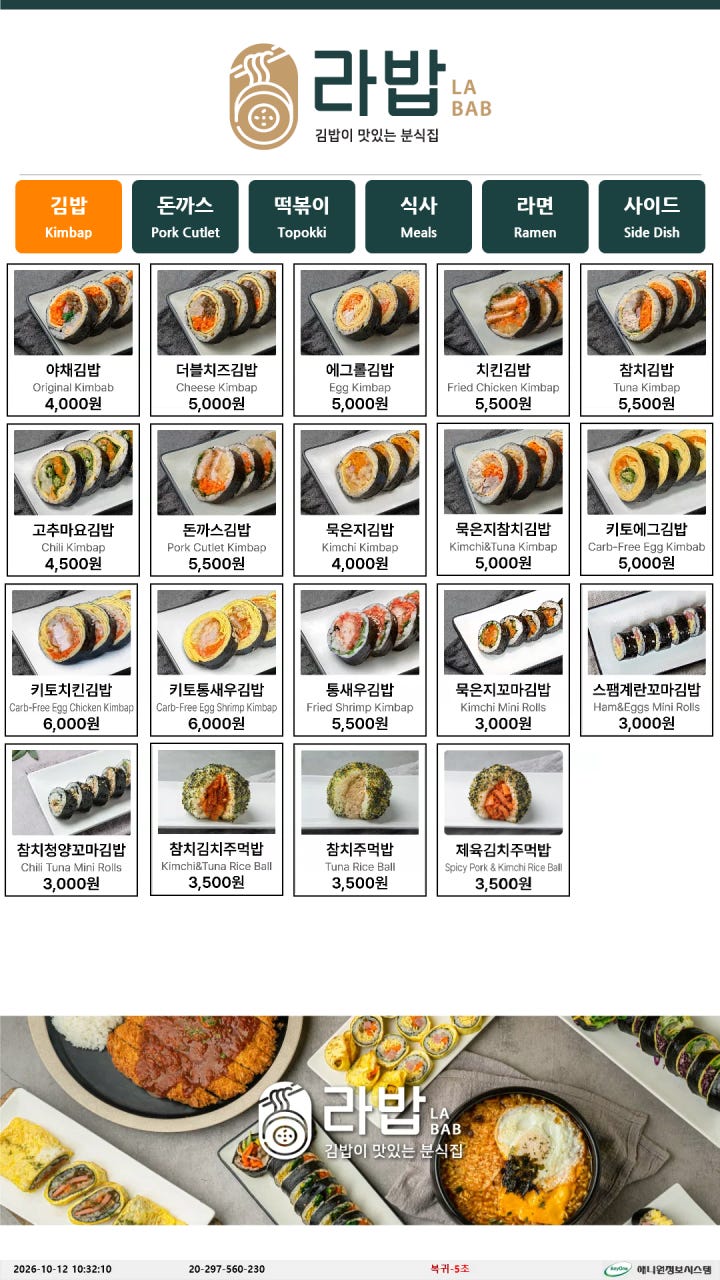
LABAB is a 24-hour Korean restaurant (franchise) chain in Seoul popular for budget-friendly kimbap, tteokbokki, ramen, rice dishes and pork cutlets. The small LABAB Itaewon (라밥 이태원점 on NAVER Maps) outlet was typically staffed by two older women – one cooking and the other serving/washing dishes. You order at a machine that takes cash and it was usually ready in 5 minutes with help-yourself Kimchi/condiments/tea/soup (as Korea is a high trust society) plus you are supposed to return your dishes to the window when done eating (which was why the place could get away with only one or two staff):
In addition, 수유리우동집 [수유리우동집 이태원역점 for the Itaewon branch / Suyuri Udon House or Suyuri Udong Restaurant (franchise) chain – the sign has a “35” in it but is otherwise only written in Korean] is a more upscale LABAB with slightly higher prices (Naver Maps menu). The order machine only takes cards; but you can still give them cash.
In addition to the free help-yourself Kimchi/condiments/tea/soup; there was also free coffee and more help-yourself side choices (as again, Korea is a high trust society):
Neither chain had the best food that I ate in Korea; but certainly better quality food than the RTE available at convenience stores and worth the higher (and still reasonable) prices.
And while convenience store Kimbap might be 3,600 Won, fresh LABAB Kimbap was 4,000-6,000 Won plus I could help myself to the help-yourself Kimchi/condiments/tea/soup while their other made-to-order meals were bigger than RTE meals. So unless you are not super hungry or you are in a super hurry, eating convenience store RTE food makes less sense.
Normally when I travel, I just stay at hostels in central locations as all I will be doing in a hotel room is sleeping/showering/working on the computer and I rather stretch a trip out over at least a few weeks.
In Seoul, I wanted to stay in what I thought was a more convenient area (nearer the train station / old city center / palaces); but Agoda kept showing me only female dorm spaces or pods being available when searching (if I’m a guy was logged into my account, why am I being shown places where only spaces in female dorms are available?)
I ended up staying twice at a popular international hostel (G Guesthouse Itaewon) in Itaewon (the foreigner / nightlife neighbourhood containing both bars and mosques) for about a week each time coming and going from Korea. The hostel was ok for the price (the local owners were super nice); but definitely lower quality than the one I stayed at in Busan. There was a basic breakfast of toast/cereal/juice/coffee/tea which is enough to get me started and increasingly all you can expect from even nice hostels in big Asian cities these days.
Itaewon also turned out to be an ok location to stay with the hostel being a few blocks from the Metro station (which has a small but very helpful tourism office) and in a quiet spot (most of the night life is on a Itaewon-ro 27ga-gil that runs parallel to the main road with the Metro under it).
However, I did not like food options available as the area is mostly bars/kebab shops/pizza/burgers/foreign food (I want to eat local food but not half the evening waiting for it and there were no night markets or hawkers nearby). It wasn’t until I searched for “bibibap” on Google Maps that I found the neighborhood LABAB outlet and eventually found 수유리우동집 이태원역점 [Suyuri Udon House] as mentioned earlier to eat at after coming back from a day of sightseeing.
In addition to the previously mentioned bi-annual K-Royal Culture Festival and annual Yeon Deung Hoe (Lotus Lantern Festival) Parade, there are daily ceremonial procession at the Gyeongbokgung Palace and Deoksugung Palace re-enacting Joseon dynasty guard duties. These are free to watch and occur multiple times daily (excluding Mondays and extreme weather days).
The Peace Plaza in front of the War Memorial of Korea (easily one of the best military museums in the world) also has a free roughly monthly changing of the guard (including traditional performances when I was there) at 2 PM. You will need to check their website for the schedule and its well worth seeing (but I would imagine its also strictly weather permitting):
You will need to make advance reservations for the Changdeokgung Secret Garden (inside the Changdeokgung Palace) as tickets are limited to 100 people per session (50 online, 50 on-site):
-
Online Booking Window: Reservations open at 10:00 AM KST, exactly 6 days before the desired visit date.
-
On-Site Tickets: The remaining 50 tickets per session are sold first-come, first-served at the ticket office starting at 09:00 on the day of the tour.
-
General Palace Admission: ₩3,000 for adults (ages 19–64).
-
Secret Garden Admission (Extra): ₩5,000 for adults, ₩2,500 for youth (ages 7–18), and free for children under 7.
-
Total Cost (Adult): ₩8,000 combined (₩3,000 palace + ₩5,000 Secret Garden).
To be frank, the gardens were ok; but if you are short of time, they can be skipped.
Although somewhat of a hassle to get to because its in the mountains 2+ hours outside the city by public transportation, the 81+ acre Garden of Morning Calm (Korea is “the land of morning calm”) is well worth a visit.
A Korean academic was apparently an exchange professor in the USA and Europe where he visited botanical gardens; but Korea had nothing similar at the time. When he went back to Korea, he had wanted to farm; but also build a garden in a good location 1-1 1/2 hours from Seoul to attract visitors.
The location he chose was a barren stone lot which had been cleared via slash-and-burn agricultural practices. He and his wife designed and labored on the gardens themselves. At one point, while experiencing financial difficulties, they sold off their house and lived in a small home on the garden’s property.
The gardens first opened to the public in 1996 with ten themed sections now has 22 sections:
I was warned by a tourist information center not to attempt to go there on a weekend during the height of the spring bloom season as the traffic congestion on the two-lane mountain roads would be bad. They also suggested a special tourism bus that went around the area and to Nami Island (which did not look particularly interesting since I had limited time).
I ended up going in the latter part of May on (I think) a Thursday. Note that it will take a couple of trains from Seoul to get there with the last commuter train having a more limited schedule.
However, I managed to luck out and only had to wait a couple of minutes for a local bus from the station going to the garden entrance in maybe 30 minutes (these buses have even more limited schedules on the weekends as they are for commuters and I guess students). Had I taken the tourist bus (also a limited schedule) from the further station the tourism information center had suggested, it would have taken forever to get there.
Even though it was already mid-May, there were still enough blooms and the garden was not overly crowded on a weekday afternoon:
There were brochures for full day or half day DMZ tours where I stayed. But frankly, they all seemed like gimmicks (e.g. stops at the DMZ Starbucks) for Instagramers to get their selfies at the DMZ. They also waste time as they require you to get up early (unless its an afternoon tour), wait for the tour bus to pick-up and drop everyone off, and travel to and from the DMZ…
Instead, I spent one of the my last days in Korea taking the Metro (figure on changing trains 3 or 4 times) to the historical city of Suwon just south of Seoul. A short ride on a city bus to the city center takes you to the 18th-century Hwaseong Fortress (the Hwaseong Haenggung replica palace sits in the middle) with around 6 Kms of walls around the city center core that you can walk (the start of which is over a small mountain). At night, the walls are also lit up – making it worth staying until after dark:
Note that many of Seoul’s walls (at least the ones on mountains) remain intact and can also be hiked.
I would have also loved to have visited the Samsung Innovation Museum, the largest electronic industry history museum in Korea, as its somewhat nearby. However, it would be very difficult to visit it and to walk the walls of Hwaseong Fortress in the same day.
I was originally planning to visit Suncheon on my way to Busan as that’s the home of the massive Suncheon Bay National Garden built for a 2013 expo.
However, I wasn’t too excited about going given its not particularly uniquely Korean plus the difficulty of stopping there from Seoul via and then going onward to Busan by train (its located at the tip of the Korean peninsula).
When looking at YouTube to find alternative places of interest more uniquely Korean, I found the city of Jeonju which is regarded as the birthplace of the Joseon dynasty (as the royal family clan was from Jeonju) along with bibimbap and kongnamul gukbap (Jeonju-style bean sprout & rice soup) plus it contains around 700 traditional Hanok buildings that have been turned into shops, restaurants and boutique hotels.
Its also convenient to visit Jeonju on the way to Busan as there are direct trains from Seoul. To get to Busan, you will need to change trains after less than an hour (then its a few more hours to Busan); but this wasn’t too difficult to do and there was only a short wait between trains.
Unfortunately, I only found out about Jeonju from a YouTube video a few weeks before going to Korea and the Monday I was planning to go there was the last day of a 5-day holiday weekend. So I did not have time to book a hanok stay at a reasonable price (I’m not sure how comfortable a hanok stay would be in summer or winter, but I am sure most have been upgraded with modern conveniences).
I ended up staying two nights for a total of only US$33 at Jeonju Just like Yesterday about a block from the train station and maybe a 20 minute bus ride (lots of regular buses) to the hanok area.
This was my first stay in a Korean style / local hotel and the room was surprisingly well equipped with soaps/towels/toiletries, etc. for the price I paid. I was even more surprised it got cleaned after my first night (with the teabags/coffee sachets replaced). However, I was at first confused as there was not much bedding on the bed; but there was actually a heating pad on it (and if I put it on too high, I would wake up sweating!):


Otherwise, I had no phone calls/knocks on the door or cards slid under the door advertising special “services” like you might encounter at local hotels in China…
There is enough to see in Jeonju for at least a full day (e.g. Gyeonggijeon Shrine, Royal Portrait Museum, etc.) with free walking tours in English available (the tourist information center would have a schedule and meeting place locations).
I would say that Jeonju is a little touristy, but its not a tourist trap and the food is excellent with reasonable prices:
And of course, you have to try the local Jeonju Bibibap made by these older Korean ladies for around 9,000 Won with enough side dishes where you won’t need another big meal for the day:
I also tried the other local specialty, kongnamul gukbap, and it was ok; but not as good as the local bibimbap…
As mentioned earlier, Busan has an absolutely spectacular setting amid mountains and the sea that makes is rival San Francisco, Cape Town and Rio de Janeiro. But unlike deindustrialized San Francisco (or other cities in the West), there is still considerable heavy industry in the city and its a major port:
In Busan, I stayed at a place called Elephant Guest House (엘레펀트 게스트하우스 남포) which was much nicer than the place I stayed in Seoul (it also had private rooms). The hostel turned out to be in a fantastic location as was only a couple of stations from the main train station below the Busan Tower and a few minutes walk from the Nampo Metro entrance, the pedestrian Gwangbok-ro Fashion Street and food hawkers plus a huge Lotte shopping mall with a free observation deck / roof garden with good views of the city/port area.
I would say this area is better or more convenient to stay in than the more isolated Haeundae beach area (there is a nice food hawker street close to the beach) that’s away from the main part of the city (and besides, the water is going to be too cold to swim in except maybe in the middle of summer). However, the Gwangalli Beach (with the Gwangan Bridge in the background) and train station areas are probably just as convenient.
Gwangalli Beach also has about a 12 minute Saturday night drone show with 2,500 drones:
Unfortunately, I missed registering for the annual Gwangandaegyo Bridge Walking Festival which occurred when I was there (I think sponsored by local media) as I had not known about it and the registration info or site was probably all in Korean. Not know about these sorts of special events is also a common headache and frustration I have long had living in Asia as even with sites like Facebook, you still miss out.
I was also too early to see the famous annual (May) Haeundae Sand Festival; but I saw the sand castles under construction or near completion which was good enough.
While walking around Busan on my way to another sight, I walked by the United Nations Memorial Cemetery (UNMCK) which I wasn’t really planning to stop at.
However, I was shocked to come upon what has to be the most beautiful cemetery in the world:
Likewise and as mentioned earlier, The War Memorial of Korea is easily one of the best military museums in the world. So clearly, Koreans appreciate the sacrifices the world made on their behalf during the war and seeing this does make me more willing to support defending them in the event they need to be defended again.
The UN cemetery is also near two more fantastic museums: The United Nations Peace Memorial Hall and the huge National Museum of Forced Mobilization under Japanese Occupation. In Seoul, I also went to the National Memorial of the Korean Provisional Government, Seodaemun Prison History Hall, Seoul Museum of History, National Museum of Korea, National Palace Museum of Korea, National Folk Museum of Korea and the National Aviation Museum of Korea.
Aside from any coverage of the Korean war, many of these museums covered the Japanese occupation which (like in China) there is clearly lingering bitterness about. After all, the Japanese had pretty much demolished most of Korea’s historical palaces and other key sites – meaning almost everything seen today are actually careful (and no doubt costly) reconstructions.
In 1969, Lee Chang-ho came to Oedo Island by accident to escape from a typhoon while he was fishing. He was charmed by the island and fell in love with it immediately. Together with his wife, they bought the island and started creating a botanical garden where everything from plants to building materials had to be brought in by barge.
Over 30 years, they transformed the uninhabited island into a spectacular botanical garden with 1,000s of plant types (including rare subtropical plants like agave and cactuses as the island has a microclimate), a Venus garden and Mediterranean-style buildings:
Getting to Oedo Island is a little complicated. I should have gone to a bus station; but instead I got confused (between NAVER Maps and a tourism information center) and ended up what turned out to be a bus stop outside a Metro station where there was actually a regular bus (presumably used by long distance commuters) that took an hour to reach Jangseungpo port for 8,400 Won (US5.60).
From the port, there is a cruise ship for 27,000 Won (US$18) with admission to the botanical garden being 11,000 Won (US$7.40). After stopping for about 1 1/2 hours at Oedo Botania, the boat also goes close to something called Geoje Haegeumgang (“Mount Kumgang of the sea”) before returning to port.
I don’t think I made a boat reservation ahead of time (something a tourism information center could help with); but that’s something you might need to do on a weekend.
Gyeongju was the capital of the ancient kingdom of Silla and an easy day trip from Busan. You just need to take one of Busan’s Metro lines all the way to the end where there is an intercity bus terminal and its less than an hour bus ride to the city (I was able to get the next bus going and coming back).
Some people where I was staying were planning to spend a night or two there; but the only thing you might miss out on by doing a day trip would be seeing some of the sites lit up at night.
Upon arrival, I stopped at the local tourism information center for maps and then took a city bus to the world class Gyeongju National Museum which is filled with artifacts from the Silla period. From there, I walked back to the bus station stopping at the other major historical sites along the way:
That concludes the trip report portion with the stock portion coming next…
Disclaimer. The information and views contained on this website and newsletter is provided for informational purposes only and does not constitute investment advice and/or a recommendation. Your use of any content is entirely at your own risk and it is your sole responsibility to evaluate the accuracy, completeness and usefulness of the content. Seek a duly licensed professional for any investment advice. I may have positions in the investments covered. This is not a recommendation to buy or sell any investment mentioned.
🇰🇷 Korea Trip Report was also published on our website under the Newsletter & EMS Analysis categories.


