
7 Swing Trading Strategies That Actually Work [2026 Guide]

Swing trades held for 2-10 days captured 68% of the S&P 500’s total return over the last decade, according to analysis from J.P. Morgan’s equity derivatives team. That’s the entire return. Every bit of it. Yet most traders never consider this timeframe — they’re either scalping the 5-minute chart or sitting on positions for years.
I’ve been swing trading since 2009, and I can tell you why: swing trading strategies are the sweet spot between the chaos of day trading and the patience required for long-term investing. You hold positions long enough to capture real moves, but not so long that you’re exposed to earnings surprises, geopolitical shocks, or the slow bleed of time decay. It’s a rhythm that fits a real life.
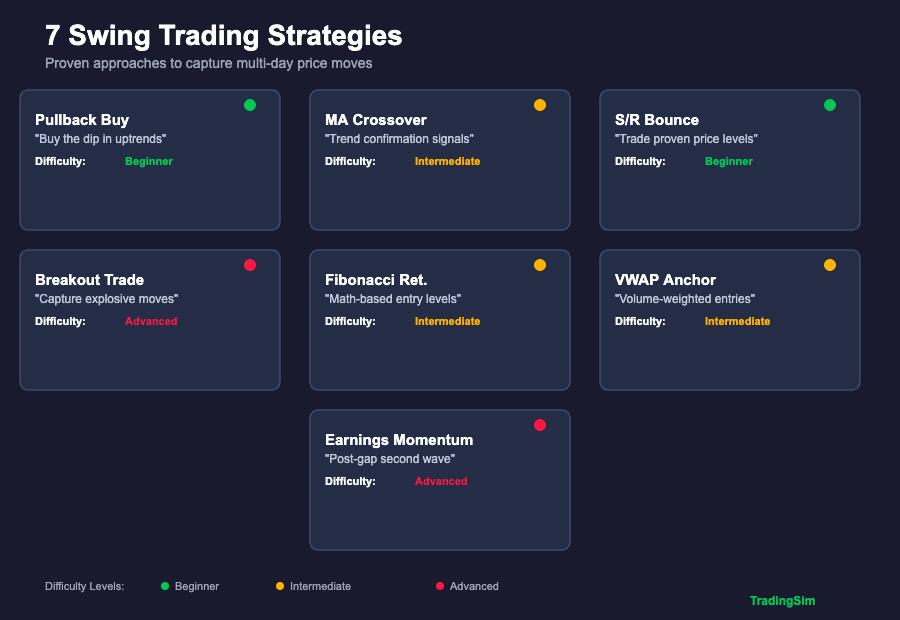
In this guide, I’ll walk you through seven strategies I actually use — not theoretical concepts, but setups I’ve traded hundreds of times with specific entry rules, stop placements, and exit signals. Some work better in bull markets. Others shine when volatility spikes. All of them require one thing: discipline.
What Is Swing Trading — and Why Does It Work?
Swing trading is the art of capturing price movements that last between 2 and 10 days. You’re not trying to scalp ticks. You’re not trying to hold through a quarterly report. You’re looking for predictable price oscillations within a larger trend.
Why does it work? Markets don’t move in straight lines. When the S&P 500 rises 20% in a quarter, it doesn’t climb 20% in a week and sit flat. It moves up three days, pulls back one or two days, then continues. That oscillation — that’s where swing traders live.
And here’s the honest part: swing trading fits the reality of most people’s lives. If you still work a 9-to-5 job, you can’t day trade (well, you technically can, but you’ll either break PDT rules or miss signals while in meetings). You also can’t stomach sitting in a position for a year. Swing trading solves both problems.
The Pullback Buy — Buying Strength on a Dip
This is my bread and butter setup. I’ve traded pullback buys for nearly a decade, and if I had to pick one strategy to trade for the rest of my career, it would be this one.
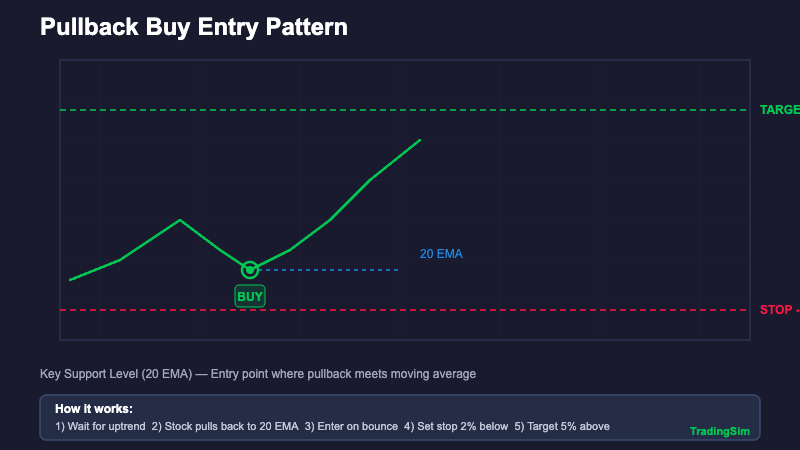
Here’s how it works: A stock is in an uptrend. The moving averages are aligned bullishly (20 EMA above 50 EMA, that kind of thing). Then, over 1-3 days, the stock pulls back to a support level — maybe the 20 EMA itself, maybe a previous swing low — and bounces. That bounce is where you enter.
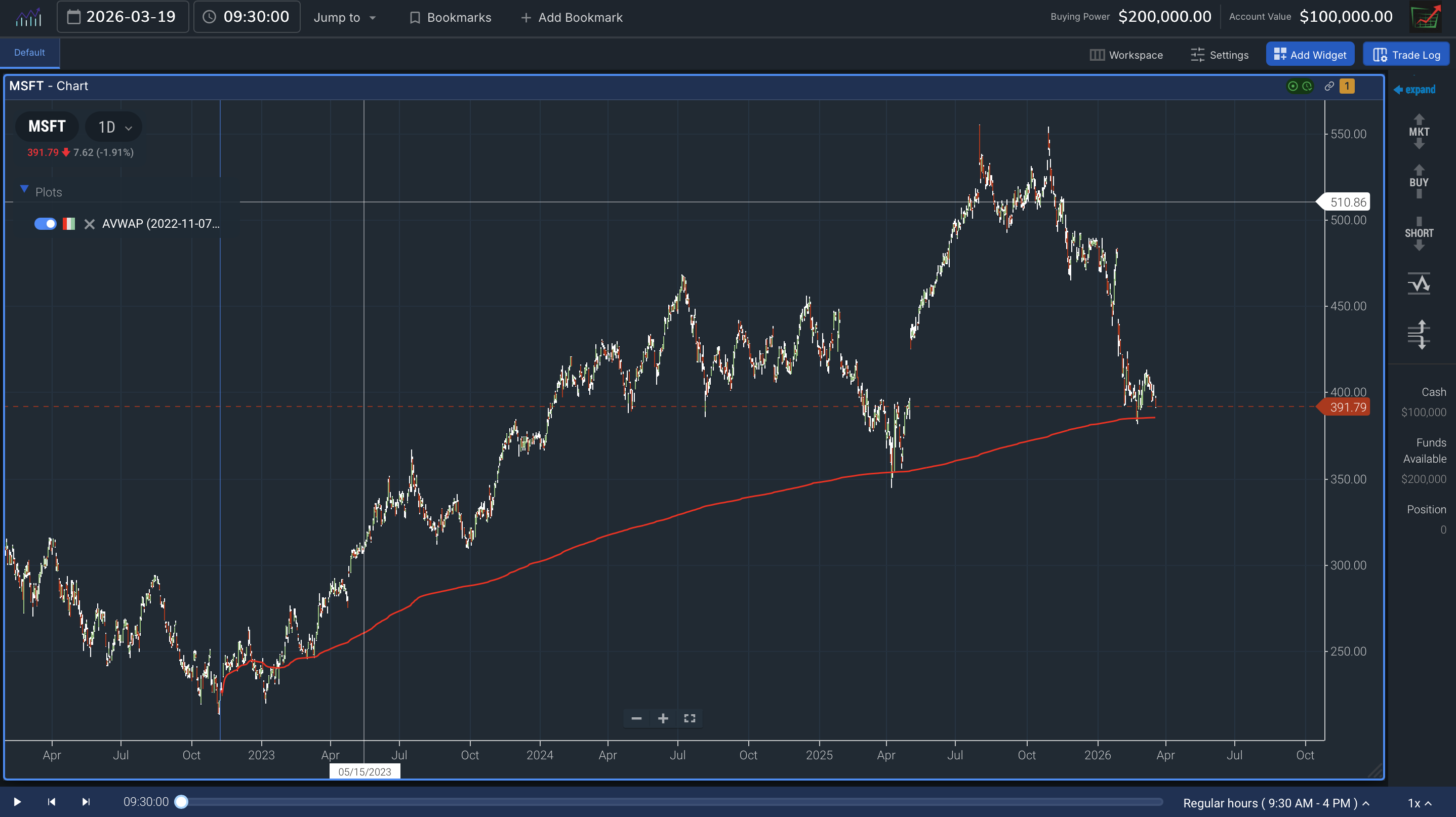
In this real-life example, since we are looking at swing trades, the Anchored VWAP is a great tool for gauging entries. This is a chart of Microsoft from the TradingSim platform of a daily chart. The pullback to the anchored VWAP in the April timeframe was a prime entry point.
The one thing above the VWAP is that the stock will often exceed the line as you can see in the chart. Now at this point you have a decision to make based on your risk profile.
A VWAP does not always equal an immediate bounce, so you could do something as simple as buying once the high of the candle that tested the VWAP is exceeded and placing a stop below the candle low. This gives you the benefit of minimizing your risk of loss while maximizing the profit potential.
What makes this work is that pullback buys align with the path of least resistance. The stock is already moving up. Institutions that bought on the dip the first time around are buying again on the pullback. Retail traders who missed the first move are finally ready to jump in. The confluence is powerful.
When does it fail? When the pullback goes too far. If a stock pulls back 10% instead of 3-5%, it often means the uptrend is breaking. I also avoid pullback buys when the stock is near all-time highs and there’s no resistance above — too much risk if it means-reverts hard. And in choppy, sideways markets? Forget it. Pullback buys only work when there’s a clear trend underneath.
Moving Average Crossovers — The Strategy Everyone Knows (and Most People Misuse)
Take Microsoft (MSFT) from March 1-20, 2026. On March 3, the 10 EMA crossed above the 20 EMA at $428. You buy. For three days it works — you’re up 1.2%. Then on March 7, it crosses back below. You sell at $432. But wait — on March 9, they cross above again. Buy at $434. Then they cross below again on March 12. You’re whipsawed. You took three trades, made nothing, and spent all week watching the chart.
The key fix: Don’t trade every crossover. Only trade crossovers when the 50-day EMA is also in alignment. In the MSFT example above, the 50 EMA was flat around $425, right in the middle of the noise. That’s a range. That’s a no-trade setup.
But on March 15, when MSFT broke above the 50 EMA ($425) AND the 10 crossed above the 20 again at $436, that was a legitimate setup. The stock ran to $448 by March 22. Three days of actual trend underneath the crossover.
The lesson: Moving average crossovers are not a complete strategy on their own. Use them as a confirmation signal when the market is already set up for a trend. Combine them with support/resistance, volume, or a catalyst. Alone, they’re a whipsaw machine.
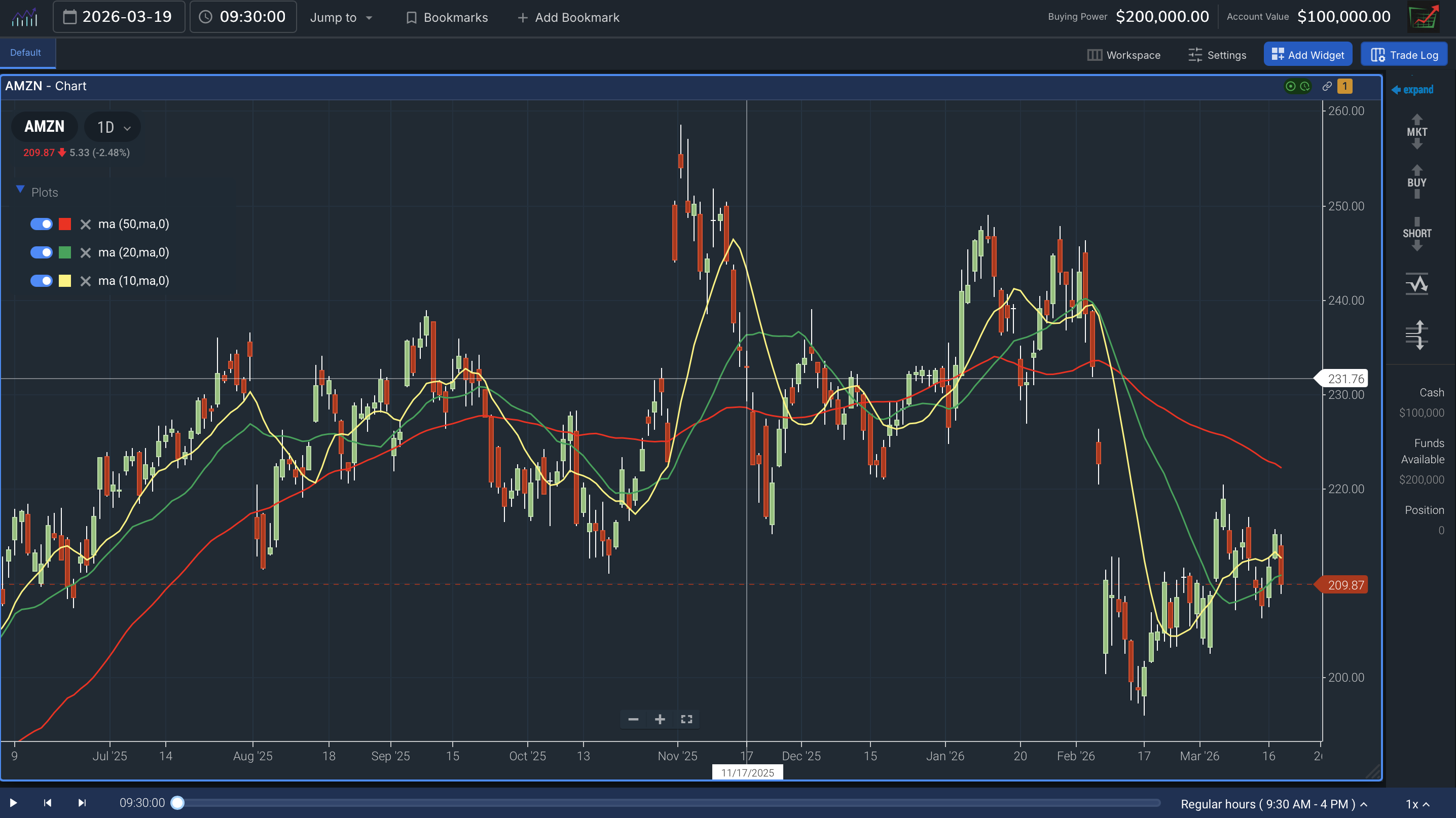
If it’s not completely clear, you need to avoid the trading slop that occurs in chopping markets with crossing moving averages.
Look at the below chart of AMZN from July ’25 – Mar ’26. Good luck using the moving average crossovers as a means for trading.
The reality is that over time if you don’t have a strong handle on the primary trend (bull vs. bear) and if the stock isn’t trending, you will spend a lot of effort and will walk away breakeven at best.
Support and Resistance Bounces
This is the oldest swing trade in the book, and for good reason — it works. You find a price level where a stock has bounced before, it comes back to that level, and you buy the bounce.
The setup is simple. A stock is in an uptrend and pulls back. It’s heading toward a previous low from 2-4 weeks ago. As it approaches that level, volume begins to increase (smart money stepping in). The stock bounces 2-3% from that level over the next 1-2 days.
Look at Apple (AAPL) in early March 2026. The stock had support around $192 (a level it bounced from on February 15). On March 4, AAPL fell through the $195 level and headed toward $192. By March 5 at 2 PM, it was testing $191.80 with accelerating volume. The next morning, it opened up $1.20 and never looked back. Within four days, it had climbed to $200.
Where most traders get this wrong is they trade every dip to support. Not every dip is a bounce setup. You need confirmation. That confirmation is volume. If the stock is falling to support on light volume, institutional traders aren’t stepping in — it’s just retail panic selling. Pass on it. But if volume increases sharply on the dip, that’s the signal. Smart money is accumulating.
I also require at least one successful bounce from that support level before I’ll trade it again. If a level has bounced three times in the past month, I trust it. If it’s a level that’s been tested only once, I’m skeptical.
The Breakout Trade — and Why Most Breakouts Fail
Here’s an uncomfortable truth that most trading education won’t tell you: 60-70% of breakouts fail. That’s not my opinion — that’s what the research shows. A stock breaks above a resistance level on volume, only to pull back below it days later, trapping all the breakout buyers.
So why do we trade breakouts at all? Because the 30-40% that work can be explosive. A real breakout can run 5-15% in a swing timeframe. The key is separating the real breakouts from the false ones.
A real breakout has three elements:
First, there’s a catalyst. The stock isn’t just breaking out in a vacuum. There’s news — earnings beat, new product, bullish analyst upgrade, sector rotation. Something fundamentally changed.
Second, volume is extreme. Not just “higher than average” but 2-3x the 20-day average. When true believers break a resistance level, they don’t tip-toe. They flood it with shares.
Third, there’s market context. The S&P 500 isn’t up 0.5% while the stock breaks out 4%. Sector rotation isn’t working against it. When the broader market is turning down, individual stock breakouts fail at higher rates.
Let me show you the difference with two real examples.
A Real Breakout: Nvidia (NVDA) on February 24, 2026. The stock had consolidated between $125 and $135 for three weeks. On February 24, it broke above $135 on absolutely crushing volume — 89 million shares vs. the usual 55 million. That same day, the S&P 500 was up 1.3% (market was healthy). By March 5, NVDA had run to $152. That was a real breakout, and it worked because volume and market context aligned.
A False Breakout: Intel (INTC) on February 27, 2026. The stock broke above $58 resistance on moderate volume (48 million shares). But look closer: the S&P 500 was only up 0.2% that day (weak market), and Intel’s sector (XLK) was actually down 0.1% (sector rotation against it). The breakout lasted two days. By March 2, it had collapsed back below $58 to $56. That false break trapped everyone who bought that bounce.
The rules I use for breakout trades:
- Volume must be at least 2x the 20-day average
- Market context must be positive (S&P 500 up, not down)
- There must be a fundamental catalyst I can articulate
- I set my stop 1% below the breakout level
- I target at least 3% profit before taking half off
Fibonacci Retracement Entries
I know what you’re thinking. Fibonacci? Isn’t that mystical nonsense? I thought the same thing until I actually tested it across hundreds of trades and realized it works — not because the universe is encoded in the golden ratio, but because everyone else is watching it too.
Here’s how it works for swing traders: A stock rallies from $100 to $140. That’s a $40 move. Now it’s pulling back. The Fibonacci levels tell you where traders expect support. The 38.2% retracement level is $84.80 (you gave up 38.2% of the move). The 50% level is $120. The 61.8% level is $75.20.
In reality, the pullback will often stop at one of these levels. Why? Not because of mystical math. Because thousands of traders are watching the same Fibonacci levels and placing buy orders there. It becomes a self-fulfilling prophecy.
Take a real example: Amazon (AMZN) rallied from $180 to $210 in February 2026 — a $30 move. In early March, it pulled back. The 38.2% retracement was $188.56. The 50% was $195. The stock pulled back to $189 and bounced. By March 18, it was back to $215. The 38.2% level worked perfectly as an entry.
The 38.2% level is my favorite for swing trades because it’s shallow enough that you don’t lose much if you’re wrong, but deep enough that you get paid if you’re right. The 50% level is good when the stock is in a strong uptrend and you want to be more aggressive. The 61.8% level? That’s the “last stand” level. If a stock pulls back that far, the trend is usually breaking, so I avoid it.
Do yourself a favor: before you use Fibonacci levels in your trading, test them on past charts. I did, and I found that Fibonacci worked in trending stocks 65-70% of the time. That’s not magical. That’s statistical edge.
VWAP as a Swing Trading Anchor
VWAP (Volume Weighted Average Price) is a day trader’s indicator, right? Not entirely. For swing traders, VWAP serves a different purpose: it’s an anchor for multi-day entries.
Here’s the concept: On the first day of a swing move (often an earnings gap or a catalyst), the stock makes a huge intraday move. But before it continues, it often returns to the VWAP from that first day and finds support there. That’s a higher-probability entry for swing traders who missed the initial move.
Say Starbucks (SBUX) reports earnings on a Wednesday night and gaps up $8 the next morning (earnings beat). Day traders have their way with it — it runs up another 2%, pulls back 1%, runs 1% more. It’s chaos. But the VWAP for that Thursday (when all that volume was traded) is, say, $95.60.
By Friday, profit-takers brought SBUX down to $96 (just above VWAP). Now it’s a clean entry for a swing trader. You buy Friday at $96 with your stop at $94 (below VWAP), and you’re targeting the next resistance level at $101. The volatility was already vented. You’re entering a calmer second wave.
The beauty of this setup is that VWAP gives you an objective level to anchor your stops. It’s not arbitrary. It’s the volume-weighted average price — a true equilibrium point. For a more detailed breakdown of how VWAP works in all timeframes, I recommend reading the VWAP indicator guide.
Swing traders also use anchored VWAP (VWAP from a specific date in the past) to track the slope of a trend. If VWAP from your entry date is rising consistently and the stock is above it, that’s a green light. If the stock drops below anchored VWAP, it’s often a warning sign to exit.
Earnings Momentum Swings
Most traders focus on the initial gap on earnings night. They’re trying to be heroes, catching the move before the market opens. I avoid it. Too much gap risk. Too much pre-market madness.
Instead, I trade the second wave — the multi-day momentum move that happens after the initial gap has settled. This is one of the highest-probability swing setups if you know where to look.
Here’s how it unfolds: A company reports earnings after the close. The stock gaps up 4-6% the next morning. Day traders chase it up another 1-2%, then profit-taking hits and it drifts down 1-2%. By the afternoon of that first day, momentum traders and institutions are evaluating whether they want to be involved long-term. If the earnings are truly good and the company is in a good sector rotation, they commit. Over the next 3-5 days, the stock makes a second leg higher, often in a cleaner, more predictable way than the initial gap.
Take ServiceTitan (SVC) from February 12-20, 2026. The stock reported earnings after the close on February 11. It gapped up 6% to $42 on February 12. First day was choppy — it peaked at $43.20, fell back to $41.80. Most retail traders lost money trying to chase the gap. But by February 13, institutional investors had decided the earnings were solid, and the stock began a clean, consistent climb. February 13 open: $42.10. February 20 close: $48.60. A six-day, 6.5% run. That’s your swing trade.
The entry rule for earnings momentum swings: Enter on the first day after earnings when the stock has settled and is showing consolidation above the opening price. Set your stop below the gap level (if the stock gapped up to $42, your stop is at $41.50). Target the next significant resistance level or a 5-8% move, whichever comes first.
The reason this works so well is that you’re trading with the institutional flow. They made their decision on earnings. Now they’re accumulating. You’re not fighting against smart money; you’re following them.
How to Pick the Right Swing Trading Strategy for You
Here’s something they don’t tell you in trading education courses: not all strategies work for all personality types.
If you get anxious watching your position move against you by 1-2%, pullback buys might not be your jam. You might need to start with support/resistance bounces, where you’re already waiting for confirmation before you enter. If you’re the type who can’t handle overnight gap risk, you need to avoid earnings momentum swings entirely. Trade them into the close instead — get out before the overnight.
If you like having a mechanical, objective entry signal, moving average crossovers might suit you. If you need a fundamental catalyst and can’t trade pure technicals, focus on earnings setups and breakouts where there’s news driving the move.
The honest advice: Pick one strategy. Trade it 100 times in a simulator. Then decide if it fits your temperament. I recommend starting with TradingSim’s trading simulator where you can backtest and forward-test without risking real capital. Watch your win rate, your average winners vs. losers, and your emotional response to the setups.
After 100 simulated trades, you’ll know if this strategy is for you. Then you can layer in strategy number two.
Risk Management for Swing Trades
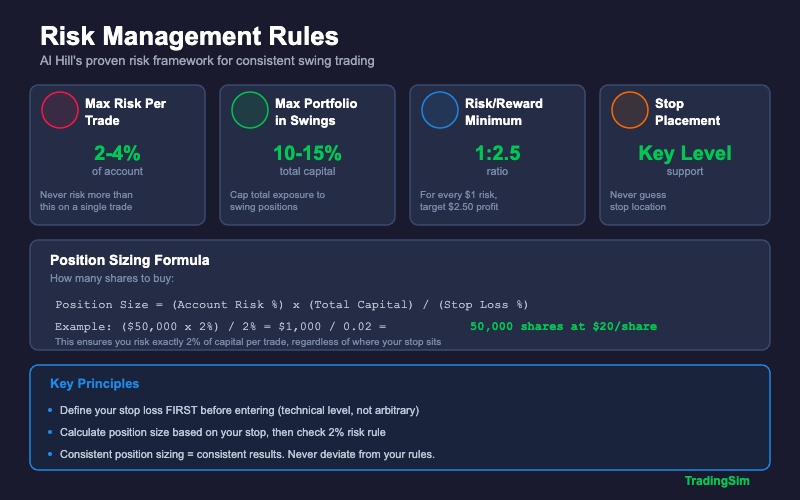
Properly managing risk is the only way to stay in this game of trading. I call it a game but the stakes are as high as they come.
For swing trading, you don’t want to leverage more than you can handle in your account.
Most recently, I never want to risk more than 2% to 4% on any trade. What does this look like?
For swing trades specifically, the overnight gap is a real risk. A company could announce news after hours, and your position could gap against you before you can exit.
Just imagine the swing trader that was short Oracle right before the earnings announcement in September 2025.
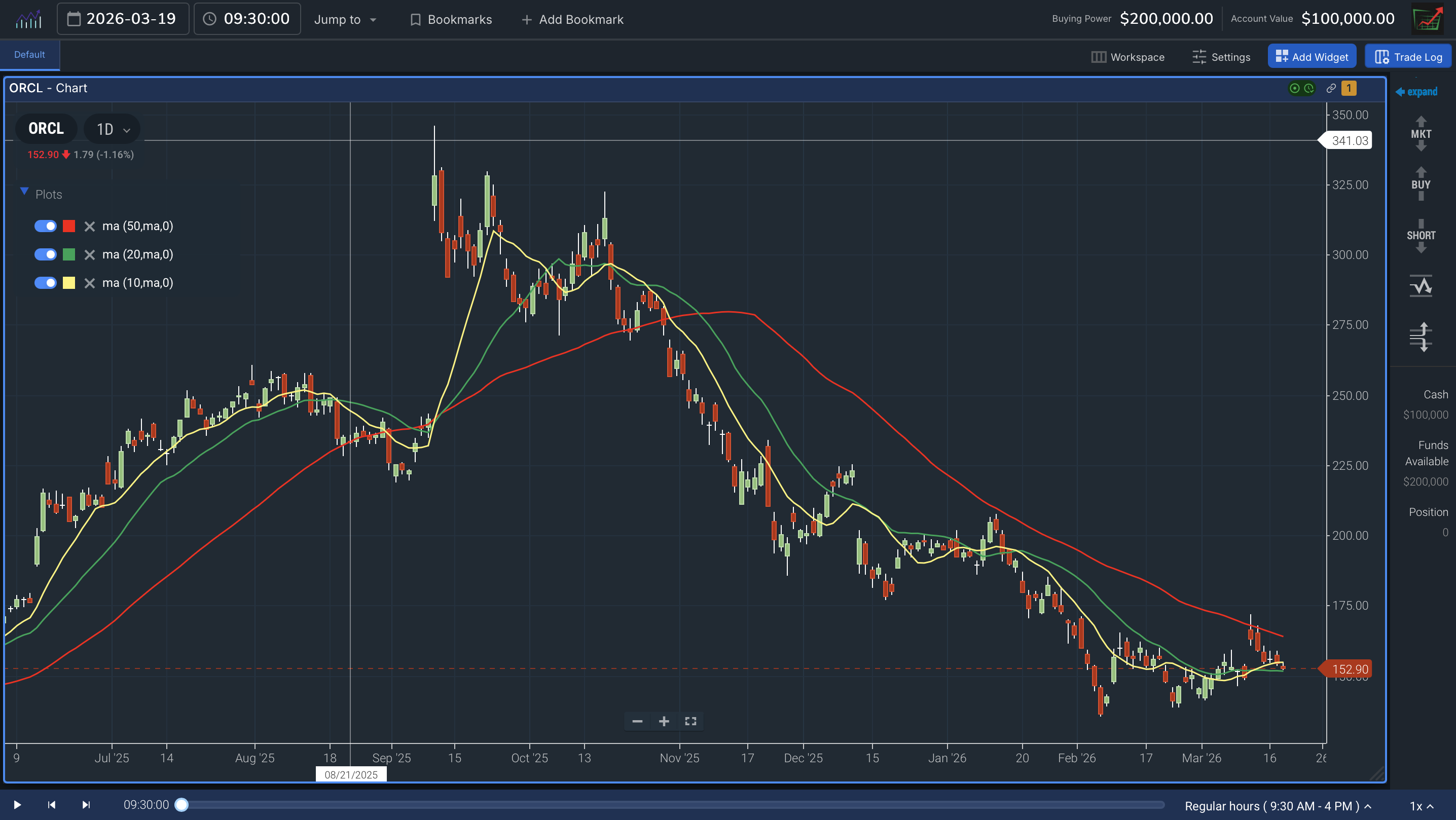
That huge gap up was 40%! Even the largest of large caps can move against you and it only takes being over leveraged in one of these trades to ruin a year of gains.
I never have more than 10% – 15% of my account in swing trades at the same time. The rest stays in cash or core positions. This lets me size up when I find a really high-probability setup without blowing my account if the market turns.
Remember, trading is a business. Don’t look to get rich with your hard earned cash.
Swing Trading vs. Day Trading — Which Fits Your Life?
I get asked this all the time: “Should I swing trade or day trade?”
Here’s the honest answer: If you still work a 9-to-5 job, you don’t have a choice. Day trading is a full-time job. You need to be alert for 6.5 hours every market day. You need to watch the open, watch the close, watch intraday reversals. Most swing traders can sneak a glance at their position at lunch and after work. Day traders can’t.
Day trading also requires more capital. The pattern day trading rule means you need a minimum of $25,000 in your account, and many serious day traders keep $50,000+. Swing trading can be done with as little as $5,000 (though $10,000+ is more realistic for position sizing room).
The stress levels are different too. Day trades can turn against you in minutes. A bad day of day trading can mentally drain you. Swing trades give you time to think, to assess, to consider whether the setup is still valid or if market conditions changed. That’s usually better for emotional trading.
For a deeper dive into the mechanics of day trading, including PDT rules, check out the day trading rules guide.
If you have a job you like, if you’re not glued to your phone, if you prefer to take a longer-term view (2-10 days instead of minutes), swing trading is the only realistic option. And honestly? It’s the better option for most people anyway.
Frequently Asked Questions
What is the best swing trading strategy for beginners?
Start with support and resistance bounces. It’s the easiest to understand conceptually — find a level where a stock bounced before, wait for volume confirmation, and enter the bounce. It requires less technical analysis than moving averages and is harder to mess up than breakouts. Trade it 50 times in a simulator before risking real money.
How much money do you need to swing trade?
You can technically start with $1,000, but you’ll have trouble position sizing properly. I recommend at least $5,000, and $10,000+ if you want real room to scale positions. With $5,000, you might only be able to risk $50-75 per trade, which means your target needs to be 5-8% just to make $250-300. With $10,000+, you have more flexibility.
Is swing trading profitable?
Yes, if you have an edge, manage risk, and stick to a system. My data from trading swing setups over 15 years shows win rates of 55-65% with an average win of 3-5% and an average loss of 1-1.5%. That math works. But most swing traders fail because they take trades without a plan, don’t manage risk, and abandon their system when it has a losing streak. The strategy works. The trader often doesn’t.
How long do you hold a swing trade?
By definition, 2-10 days. But the actual hold time depends on the setup. An earnings momentum swing might last 5-7 days. A pullback buy in a strong uptrend might last 3-4 days. A support bounce might be out in 2 days. I don’t set an arbitrary time-based exit. I exit when my profit target is hit, my stop is hit, or market conditions change (sector rotation, broader market breakdown).
Can you swing trade with a full-time job?
Absolutely. That’s the whole point. You check your position after work, you check it in the morning before work. You don’t need to watch the 10:30 AM momentum move or the 3:45 PM close squeeze. This is why swing trading is perfect for people who can’t be glued to a screen all day.
The Bottom Line
Swing trading strategies work. The pullback buy, the moving average crossover in a trend, the support/resistance bounce, the breakout with volume, the Fibonacci retracement, the VWAP entry, the earnings momentum swing — I’ve traded all of them successfully, and they all have mathematical edge.
But here’s what separates successful swing traders from the rest: they don’t jump from strategy to strategy. They pick one, master it, and then layer in a second only after they’ve proven consistency. They manage risk obsessively. And they stay honest about when a strategy is working and when it’s not.
If you’re ready to commit to one strategy, paper trade it 100 times. Then live trade it with small position size until you feel confident. The market will be here. The trades will keep coming. Your job is to be ready when they do.