
Amid E. coli outbreak, Raw Farm owner rejects claims by weakened FDA
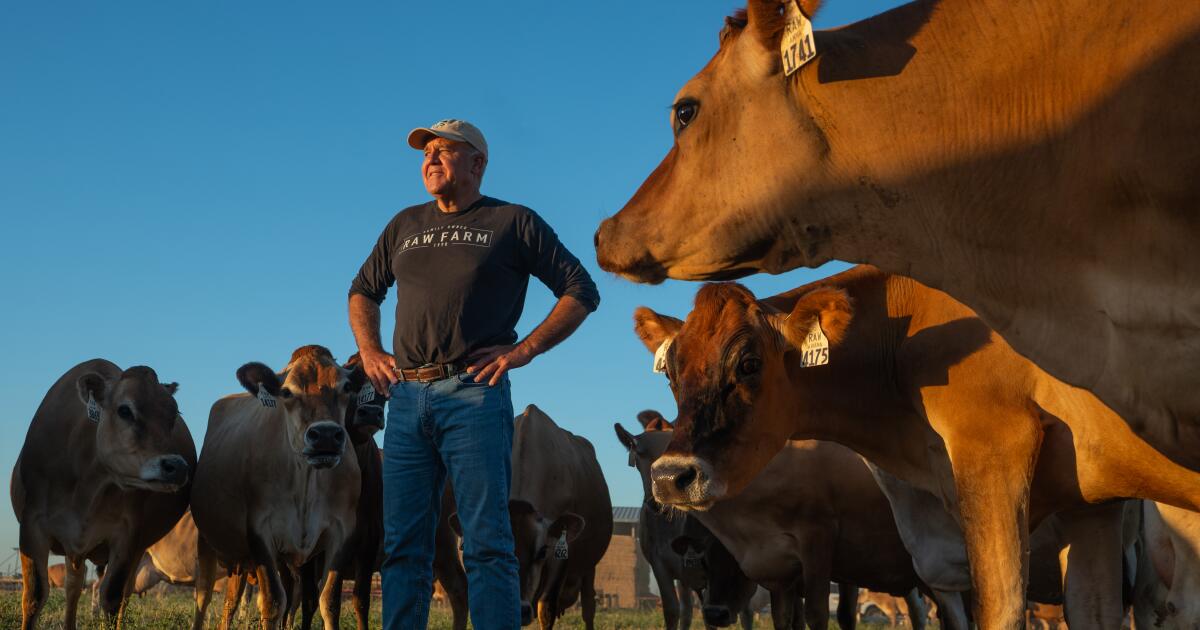
Mark McAfee is standing by his cheese.
The U.S. Food and Drug Administration has asked McAfee’s Fresno-based Raw Farm to voluntarily pull its unpasteurized cheese products from the market as the agency investigates an E. coli outbreak that has sickened nine people in three states — seven of them in California.
The U.S. Centers for Disease Control has warned the public not to buy, sell or serve the company’s raw cheddar cheese, which five of those who had an E. coli infection say they ate before their illness.
But McAfee is holding firm. The FDA has yet to confirm that E. coli has been found in any Raw Farm products, he said. The agency has not issued a formal recall, though it has sent out a warning letter telling customers to avoid Raw Farm products purchased on or after Jan. 4, particularly raw milk cheddar cheese.
McAfee said he tests every batch of milk that comes out of his milking parlors, and none have been positive for E. coli, salmonella, campylobacter, listeria or any other contaminant that causes human illness. He has shared those results with both the FDA and state regulators, he said.
“There’s no pathogenic bacteria correlating us to anybody,” said McAfee. “What they did was a backdoor move. They said, ‘we’ll just let everybody know we’re concerned,’ and that is enough to have stores kick you out.”
The FDA has not yet responded to requests for comment.
Last month, the FDA and Centers for Disease Control and Prevention announced an investigation into an E. coli outbreak that since September has sickened nine people in California, Florida and Texas, three of whom have been hospitalized. More than half the cases are children aged 5 or younger. One patient required treatment for hemolytic uremic syndrome, a serious kidney complication.
Genome sequencing of E. coli isolated from each patient found that the strains were closely genetically related, suggesting that all of the ill people were exposed to the same source of infection.
State and local public health officials were able to interview eight patients or their caregivers. All said they’d consumed raw dairy products before falling ill. Two whose illness started in late 2025 said they drank Raw Farm’s raw milk, and five who fell sick in 2026 had eaten the company’s raw cheddar. (The eighth couldn’t recall the brand of the raw milk they drank.)
While testing of retail samples of Raw Farm cheese on sale in March found no E. coli, California has not ruled out the farm as the outbreak’s source given the number of patients who consumed its products before infection, a California Department of Public Health spokesperson said.
“Retail cheese samples collected do not represent all raw cheese products sold by Raw Farm and may have been from different lots of production than those consumed by ill persons,” the agency said in a statement. “CDPH considers Raw Farm raw dairy the source of the outbreak based on this strong epidemiologic data, despite the negative laboratory testing results from a limited sample of retail products.”
Raw, or unpasteurized, dairy has not undergone the heating process that kills harmful bacteria while leaving nutrients largely intact. Raw Farm’s products alone have been associated with at least 239 reported cases of food poisoning since 2006, including a salmonella outbreak in October 2024 that sickened 171 people, according to Bill Marler, a food safety lawyer with Seattle-based MarlerClark.
He said the FDA’s decision to send out a warning letter instead of issuing a recall is “completely normal,” and the agency is very conservative when it comes to food safety.
“It makes sense, under the circumstances, to pull the product from the shelves,” he said of grocery stores. “Hell, if I was a retailer, I would pull it, because the last thing you’d want to do is have the product on the shelf, have it test positive for some E. coli, and have it poison some little kid and who then gets kidney failure.”
Proponents of raw dairy have long insisted that it prevents allergies and promotes beneficial bacteria, claims that are not supported by research. They include U.S. Health and Human Services Secretary Robert F. Kennedy Jr., a longtime fan who celebrated the release of the 2025 “MAHA Report” with a shot of raw milk.
McAfee was among those hopeful that Kennedy’s tenure would usher in a more favorable regulatory environment for raw dairy producers. But despite having been contacted by Kennedy surrogates before Trump’s second inauguration, he’s not heard from them since.
He said the administration has done little to promote raw dairy as part of a revamped food policy that emphasizes meat and whole-fat milk as essential for a healthy diet.
The FDA’s webpage about raw dairy was last updated during the Biden administration, and cautions people to avoid raw milk products and dispels research claiming it is healthy.
“They fired their best people at FDA and hired some good people and weird people and whatever,” McAfee said. “It’s so emblematic of a three ring circus. The entire freaking administration is showing that through their lack of consistency, the lack of policy adherence, they just do what the hell they want to do.”
What has changed under the new administration is the FDA’s ability to carry out investigations like the one it says it has initiated at Raw Farm. Inspections, lab work and outbreak investigations are among the agency functions most hindered by significant staff reductions that have taken place since Trump took office, industry experts have warned.
The Department of Health and Human Services has lost 18,200 employees since Trump took office, according to the Department of Personnel Management’s Federal Workforce Data tool. More than 3,000 of those losses were at the CDC, and about 4,500 were at the FDA.


